Fabrication of CNT Nanorings and Nanonecklaces via Controlled Polymer Crystallization
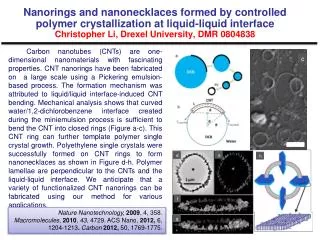
This research explores the formation of carbon nanotube (CNT) nanorings and nanonecklaces through a Pickering emulsion process at the liquid-liquid interface. The controlled bending of CNTs occurs due to the curved water/1,2-dichlorobenzene interface, enabling the creation of closed rings. These CNT structures serve as templates for polymer single crystal growth, resulting in unique nanodevices. Our method opens avenues for developing various functionalized CNT nanorings for diverse applications across materials science, enhancing the potential of nanotechnology.

Fabrication of CNT Nanorings and Nanonecklaces via Controlled Polymer Crystallization
E N D
Presentation Transcript
Nanorings and nanonecklaces formed by controlled polymer crystallization at liquid-liquid interfaceChristopher Li, Drexel University, DMR 0804838 c Carbon nanotubes (CNTs) are one-dimensional nanomaterials with fascinating properties. CNT nanorings have been fabricated on a large scale using a Pickering emulsion-based process. The formation mechanism was attributed to liquid/liquid interface-induced CNT bending. Mechanical analysis shows that curved water/1,2-dichlorobenzene interface created during the miniemulsion process is sufficient to bend the CNT into closed rings (Figure a-c). This CNT ring can further template polymer single crystal growth. Polyethylene single crystals were successfully formed on CNT rings to form nanonecklaces as shown in Figure d-h. Polymer lamellae are perpendicular to the CNTs and the liquid-liquid interface. We anticipate that a variety of functionalized CNT nanorings can be fabricated using our method for various applications. e d h f Nature Nanotechnology, 2009, 4, 358. Macromolecules, 2010, 43, 4729. ACS Nano, 2012, 6, 1204-1213.Carbon 2012, 50, 1769-1775. g
Nanorings and nanonecklaces formed by controlled polymer crystallization at liquid-liquid interface Christopher Li, Drexel University, DMR 0804838 • Education • Under this grant, one PhD student have graduated, two students are pursuing their PhD degrees. Four BS/MS students have graduated. Two of them are pursuing their PhD degrees at the University of Pennsylvania. One BS/MS student and one undergraduate students have also been supported. • Outreach • We participated Philly Materials Day, which attracted ~ 1000 participants. • We hosted ASM Materials Camp during Summer 2012. • We hosted ~200 high school students from nearby schools as part of our summer outreach program at Materials Science and Engineering Department at Drexel University. Elementary school girls are learning how to make slime on our annual Philly Materials Day.