Download
1 / 9
90 likes | 186 Vues
Explore how Server Pools, Entities, Protocols, and Failover Support in RSerPool Architecture provide reliability by addressing network and host failures. Learn about lightweight client support and state sharing mechanisms.

E N D
Reliable Server PoolingArchitecture Michael Tüxen tuexen@fh-muenster.de
The Motivation • Build systems without a single point of failure by using servers not being highly reliable. • SCTP addresses network failures. • RSerPool addresses host failures (as much as possible).
Server Pools • Use a set of servers instead of one. • Identify them by a Pool Handle (PH). • Provide a mechanism to resolve PH to transport addresses. • State sharing between the servers is out of scope of RSerPool
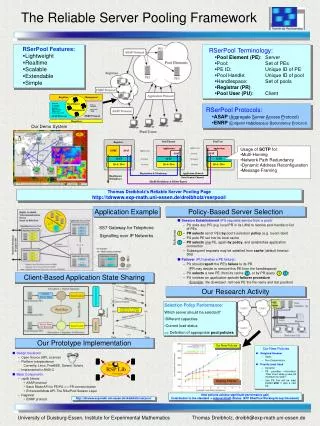
Entities in the Architecture • Pool Elements (PEs) • the servers in a server pool. • Pool Users (PUs) • the clients. • Name Servers (NSs) • the entities performing the name resolution.
PE PE PE PE PE NS NS Communication relations PU PU
Protocols • Aggregate Server Access Protocol (ASAP) • PE <-> NS • PU <-> NS • PU <-> PE (Enhanced Mode) • Endpoint Name Resolution Protocol (ENRP) • NS <-> NS
What are the protocols used for? • ASAP • Registration of PEs. • Re-registration of PEs. • Supervision of PEs. • Name resolution. • Failover support. • ENRP • Complete state sharing between the NSs.
General Considerations • Lightweight Client have to be supported. • Two entities are in the transport address selection involved. • There are other applications for RSerPool: distributed computing, support for transport layer mobility, ...
Failover Support • Business Cards for PUs being PEs. • Last Will for preferred PEs to fail over. • State Cookie for state synchronization. • Only available in Advanced Mode.