Altitudes–On- Hypotenuse Theorem
90 likes | 220 Vues
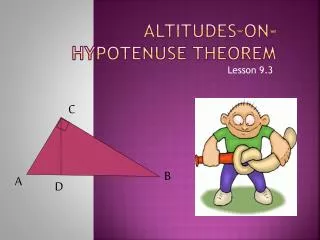
This lesson explores the Altitude Theorem, focusing on right triangles. When an altitude is drawn to the hypotenuse of triangle ABC, three similar triangles, ACD, ACB, and CDB, are created. The theorem states that these two triangles formed are similar to the original triangle and to each other. Furthermore, the altitude serves as the mean proportional between the segments of the hypotenuse. We will solve problems using examples, such as finding segments of the hypotenuse given certain measurements, and delve into the properties of similar triangles.


Altitudes–On- Hypotenuse Theorem
E N D
Presentation Transcript
C B A D Altitudes–On- Hypotenuse Theorem Lesson 9.3
A B D Altitude CD drawn to hyp. of △ABC C Three similar triangles are formed. A C B D D A C B C Three similar triangles: small, medium and large.
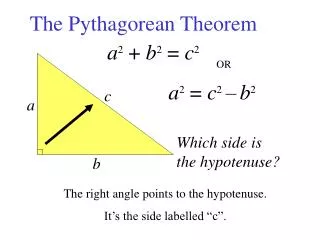
C B A D Theorem 68: If an altitude is drawn to the hypotenuse of a right triangle then, • The two triangles formed are similar to the given right triangle and to each other. Δ ADC ~ Δ ACB ~ Δ CDB
C B A D • The altitude to the hypotenuse is the mean proportional between the segments of the hypotenuse. x = h or h2 = xy h y a b h y x c
C B A D • Either leg of the given right triangle is the mean proportional between the hypotenuse of the given right triangle and the segment of the hypotenuse adjacent to that leg (ie…. the projection of that leg on the hypotenuse) y = a or a2 = ycorx = b or b2 =xc a c b c b a h x y c
If AD = 3 and DB = 9, find CD. (CD)2 = AD • DB x2 = 3 • 9 x = ± x = ± CD =
If DB = 21 and AC = 10, find AC. (AC)2 = AD • AB 102 = x(x + 21) x(x + 21) = 10 • 10 x2 + 21x – 100 = 0 (x + 25)(x – 4) = 0 x + 25 = 0 OR x – 4 = 0 x = -25 OR x = 4 Since AD cannot be negative, AD = 4.
Given • segments form rt s • Same as 2 • Given • A segment drawn from a vertex of a Δ to the opposite side of an altitude. • If the altitude is drawn to the hypotenuse of a rt. Δ, then either leg of a given rt. Δ is the mean proportional between the hypotenuse adjacent to the leg. • Reasons 1-6 • Transitive Property • PK JM • PKJ is a rt. • PKM is a rt. • RK JP • RK is an altitude. • (PK)2 = (PR)(PJ) • Similarly, (PK)2 = (PO)(PM) • (PO)(PM) = (PR)(PJ)