SlideServe
Menu
Préférences
© SlideServe · v2026

Charmed Baryons at Belle

sydney-ayers avatar
19 diapositives · 378 Views · Oct 25, 2014

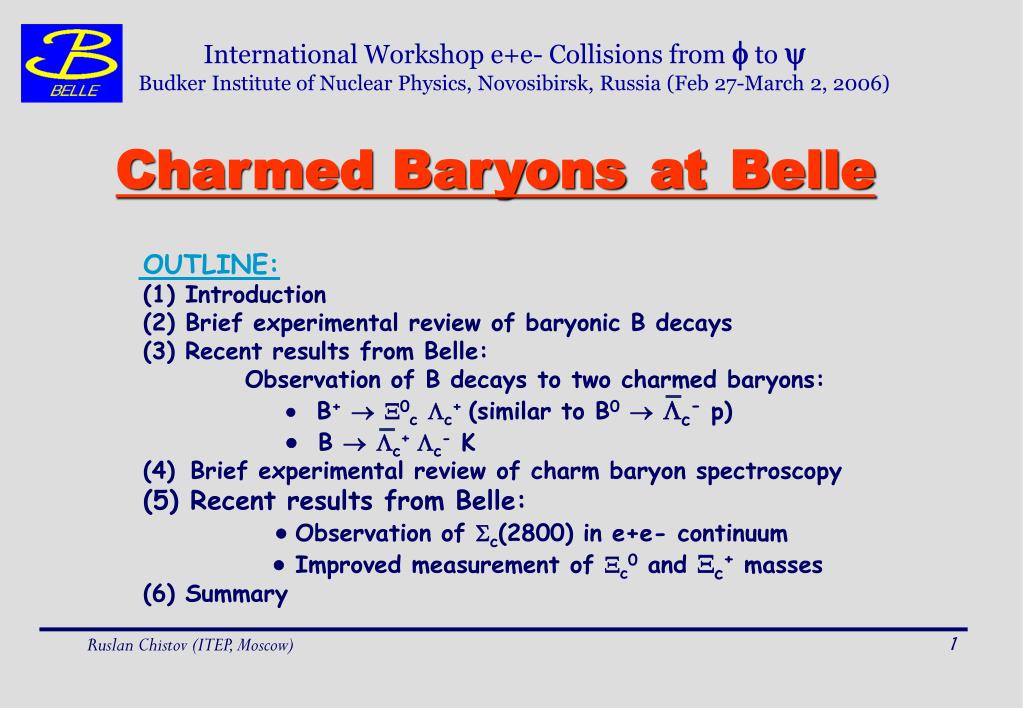
Charmed Baryons at Belle. International Workshop e+e- Collisions from  to  Budker Institute of Nuclear Physics, Novosibirsk, Russia (Feb 27-March 2, 2006). OUTLINE: (1) Introduction (2) Brief experimental review of baryonic B decays (3) Recent results from Belle:
Charmed Baryons at Belle - slide 1
01 / 19Charmed Baryons at Belle
1 / 17

Télécharger la présentation

Charmed Baryons at Belle
Une image / un lien ci-dessous est fourni (tel quel) pour télécharger la présentation

Politique de téléchargement : le contenu du site vous est fourni TEL QUEL pour votre information et votre usage personnel ; il ne peut être vendu, concédé sous licence ni partagé sur d’autres sites sans l’accord de son auteur.Le contenu vous est fourni TEL QUEL, pour votre information et votre usage personnel uniquement. Téléchargez la présentation en cliquant sur ce lien. Lors du téléchargement, si vous ne parvenez pas à télécharger une présentation, l’éditeur a peut-être supprimé le fichier de son serveur.Pendant le téléchargement, si vous ne parvenez pas à obtenir une présentation, le fichier a peut-être été supprimé par l’éditeur.

F I N

Plus de contenu associé

Transcription de la présentation
  1. Charmed BaryonsatBelle International Workshop e+e- Collisions from  to  Budker Institute of Nuclear Physics, Novosibirsk, Russia (Feb 27-March 2, 2006) • OUTLINE: • (1) Introduction • (2) Brief experimental review of baryonic B decays • (3) Recent results from Belle: • Observation of B decays to two charmed baryons: •  B+0c c+ (similar to B0  c- p) •  B  c+ c- K • Brief experimental review of charm baryon spectroscopy • Recent results from Belle: • Observation of c(2800) in e+e- continuum •  Improved measurement of c0 and c+ masses • (6) Summary Ruslan Chistov (ITEP, Moscow)

  2. Introduction Now B-factories Belle and BaBar are the reachest sources of charmed baryons. They could provide new knowledge about the spectroscopy, decay modes and production mechanism of charmed baryons. Charmed baryons in e+e- cc continuum Study of baryonic B decays Ruslan Chistov (ITEP, Moscow)

  3. Experimental Review of Baryonic B Decays(1) Ruslan Chistov (ITEP, Moscow)

  4. Experimental Review of Baryonic B Decays(2) Histograms are phase space expectation Ruslan Chistov (ITEP, Moscow)

  5. Experimental Review of Baryonic B Decays (3) Ruslan Chistov (ITEP, Moscow)

  6. B0  c- p and B+0c c+ PRL 90, 121802 (2003) Belle Br=(2.19+0.56-0.49+-0.32+-0.57)x 10-5 Consistent with the pole model prediction  but 100 times smaller than QCD sum rule predictions and diquark models One can expect Br ~ 10-5 Ruslan Chistov (ITEP, Moscow)

  7. Observation of B+0c c+ hep-ex/0510074 So, the naïve expectation is wrong Ruslan Chistov (ITEP, Moscow)

  8. Evidence for B+-c c+ hep-ex/0510074 Ruslan Chistov (ITEP, Moscow)

  9. Observation of B- c+ c- K+ hep-ex/0508015 The Br’s of 2- and 3-body double charm baryonic decays are approximately the same in contrast of single charm baryonic decays. Ruslan Chistov (ITEP, Moscow)

  10. Observation of B0 c+ c- K0 hep-ex/0508015 Ruslan Chistov (ITEP, Moscow)

  11. Experimental review of charm baryon spectroscopy Charmed baryon spectroscopy is an excellent laboratory to study the dynamics of light diquark in the environment of heavy C-quark.  Many theoretical predictions and approaches could be tested. History: ARGUS(1993) observed first excited charmed baryon c(2625)+, then CLEO(1993) confirmed it and observed c(2593)+, E687 and ARGUS subsequently confirmed the latter. Next observations came from CLEO: c(2520)+, c(2765)+, c(2880)+. Belle(2005): Observation of first orbital excitation of c : c(2800). Ruslan Chistov (ITEP, Moscow)

  12. Observation of c(2800): Results (PRL 94, 12202 (2005)) Feeddown from c(2880)+ Signal c+sideband Ruslan Chistov (ITEP, Moscow)

  13. Observation of c(2800): Results (PRL 94, 12202 (2005)) Xp spectra of observed resonances p=0.078+0.021-0.017 p=0.095+0.032-0.024 p=0.069+0.015-0.012 Peterson parameters are similar to those for other excited charm baryons in e+e- annihilation at s ~ 10.6 GeV Ruslan Chistov (ITEP, Moscow)

  14. Observation of c(2800): Discussion Theoretical models predict a rich spectrum of excited charmed baryons in the vicinity of the c(2800) [L.A.Copley, N.Isgur and G.Karl, Phys. Rev D 20, 768 (1979)]. One of the candidates is a c2 doublet with JP=3/2- and 5/2- (subscript 2 denotes the total angular momentum of light diquark.) c2 is expected to decay principally intoc+ in D-wave. The predicted mass is close to the measured but the predicted width is only 15 MeV. But the c2 (3/2-) can mix with the nearby c1 (3/2-) which would produce a wider physical state. Ruslan Chistov (ITEP, Moscow)

  15. Improved measurement of c0 and c+ masses PLB 605, 237 (2005) The c’s are reconstructed in 7 decay modes Ruslan Chistov (ITEP, Moscow)

  16. Improved measurement of c0 and c+ masses PLB 605, 237 (2005) +0.2-1.4 +0.2-1.4 Ruslan Chistov (ITEP, Moscow)

  17. Summary (1) Belle observed new type of B decays: B+c0 c+ and B  c+ c- K - decays to two charmed baryons These are the bccs transitions that have not been observed previously. The B  c+ c- K have prominent Br but small energy release. The Br(B+c0 c+) is presumably 100 times larger than the bcud analog: the B0  c- p decay. The question is to theoretically understand these observations (coherent and unified description of baryonic B decays). (2) NEW Charmed Baryon is observed by Belle: c(2800) (3) Belle measured the 0cand c+ masses with high accuracy  Large statistics collected by Belle opens a possibility for study of B->baryons and new charmed baryons  understand underlying QCD effects in heavy hadron system. Ruslan Chistov (ITEP, Moscow)

  18. KEKB asymmetric e+e- collider • Two separate rings • e+ : 3.5GeV • e- : 8.0GeV • Crossing angle 22mrad • Ecm : 10.58GeV • c  200m • Beam size: • x = 100m • y = 3m • Luminosity: • design: 1.0x1034 cm-2s-1 • achieved: 1.07x1034 cm-2s-1 Ruslan Chistov (ITEP, Moscow)

  19. Belle detector Ruslan Chistov (ITEP, Moscow)