Download
1 / 21
220 likes | 348 Vues
This guide delves into the fascinating bodies of our solar system, exploring their characteristics, movements, and classifications into inner and outer planets. You will learn about each planet's position from the Sun, surface composition, number of moons, and other intriguing facts. From the rocky terrains of Mercury to the gaseous giants of Jupiter and Saturn, we cover essential aspects such as orbital distances measured in Astronomical Units (AU), planetary formation, and unique features of celestial bodies—including Pluto, the double planet.

E N D
Introduction to the Solar System BY: BRIANNA SHIELDS
Do Now • Do other solar systems exist???
GOAL • To be able to describe the bodies found in our solar system and the way in which they move
Become a planet expert……… • 1. Numbered position from sun • 2. Inner or outer planet? • 3. Describe surface? What is it made of? • 4. Number of moons? Rings? • 5. Temperature • 6. Any other interesting info
The planets • Mercury • Venus • Earth • Mars • Jupiter • Saturn • Uranus • Neptune • Pluto
Planetary Distances • Distances between planes measured in Astronomical Units (AU) • 1 AU= distance from Earth to the Sun (150 million km)
Planetary Orbits • Planets revolve around the sun in elliptical orbits (oval) • http://www.amastro.org/at/pl/plo.html
Formation of the Solar System • The solar system formed from a huge swirling cloud of gases and dust specks. The mass fell to the center and became a star (SUN) • Some of the dust and frozen gases stuck together in clumps (large clumps became planets)
MERCURY- The god of commerce and thievery • Closest to sun • Hot days, cold nights • Rocky surface • Revolves quick • No rings or moons • Slow rotation • Iron/metal core
VENUS- God of Love and Beauty • 2nd from sun • Slow rotation- backwards • Solid rock • Clouds- greenhouse effect • No rings or moons • Metal core
EARTH • 3rd from sun • Moderate temps • Metal core, rocky surface • One moon, no rings • Life, liquid water
MARS- God of War • 4th from sun • Rust color w/ pink sky • Icecaps • Metal core, rocky surface • No rings, 2 moons
JUPITER- King of Gods • 5th from sun • Largest • Gas surface, rock core • Colored clouds, storms • Thin ring, 12 moons • Great red spot • Shortest day - 10 hrs
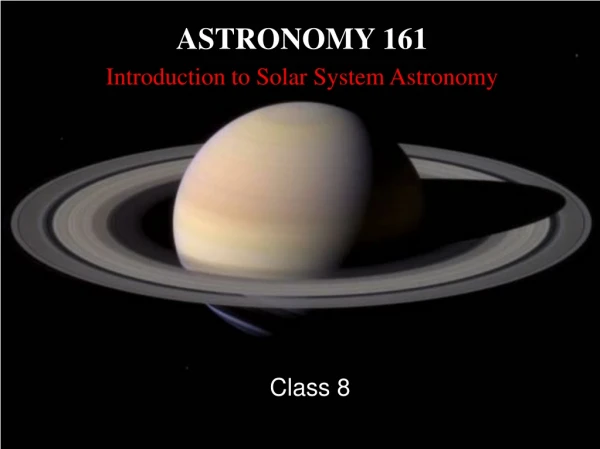
SATURN- Father of Jupiter • 6th from Sun • Least dense, made of gas • Large, spins quick • High winds • 7 rings, 18 moons
URANUS- God of the Heavens • 7th from Sun • Large, gaseous • Blue, thick clouds • Rock & ice • 15 moons, 11 rings • Spins sideways
NEPTUNE- God of the Sea • 8th from sun • Large, gaseous • Windiest, scooter cloud • Great dark spot • 8 moons, 4 rings • Rock core
PLUTO- God of the Underworld • 9th from Sun • Cold, ice and rock surface • Eccentric orbit • Double planet • Moon-Charon
INNER PLANETS Hard, rocky surface Atmosphere Metal core Warm temps No/few moons No rings Mercury, Venus, Earth, Mars OUTER PLANETS Gaseous surface Giant size Colorful clouds Many moons Many rings Cold/icy temps Exception: Pluto Jupiter, Saturn, Uranus, Neptune Inner vs. Outer Planets
Solar System Websites • What are the actual positions of each planet in their orbit right now? • Shape of each planet’s orbit • Comparing planet size
Assessment • What is the difference between a meteoroid, meteorite and a meteor? • What is the difference between an asteroid and a meteoroid? • How does a comet differ from an asteroid and meteoroid? • What is the energy source for our solar system?
Assessment • Which planet is the largest? • Which planet is fourth from the sun? • Which planet is known as the double planet and why? • Name the four inner planets • What is one characteristic of all/most outer planets • What is one characteristic of all/most inner planets