Download
1 / 15
150 likes | 264 Vues
Join us on January 16, 2014, for a parent meeting focused on the basics of creating a successful science fair project at Pecan Creek. We will cover essential topics, including testable questions, forming a hypothesis, organizing materials, and documenting procedures. Learn how to collect and present data effectively using tables, charts, and graphs. We will also discuss the importance of trials and how to follow guidelines, including regulations for using animals. Let’s ensure our 5th graders have fun while exploring their curiosity through science!

E N D
Pecan Creek Science Fair Parent Meeting January 16, 2014
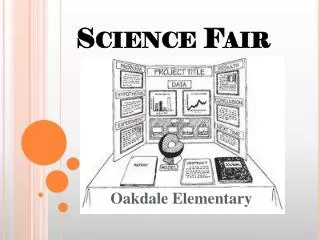
The Basics of a Science Fair Board • Testable ? • Hypothesis • Materials • Procedures • Data Collection • Tables, Charts, Graphs • Science journal or notebook for notes • Written Report: 5th grade
Projects • The project should be based on a ? That the student has. It doesn’t have to be something that is difficult…….Most often times, the best projects are the ones that students just have a curiosity of……such as: • I wonder if……….?
Trials • Scientists will conduct 3 or more trials to validate their hypothesis • Record all data • Repeat the steps of each trial exactly the way you did on trial 1 for validation • Record the data from the trials
Testable ? • A testable ? Is one that can be done safely at home or school with minimal supplies or money. • Ex. Are boys more accurate than girls when shooting a Nerf gun at a target from different paces…..ie. 10 paces, 15 paces, 20 paces
Non-testable ? • A question is non-testable when it is NOT safe or can NOT be done at home or school. • Ex. How much does an elephant weigh?
Hypothesis • An hypothesis is an educated guess on what YOU think the project will accomplish. • Example: I think that boys will be more accurate at shooting a Nerf gun at a target because they have more experience.
Materials • LIST everything you used to conduct your trials. EVERYTHING, if mom helped you, list her as a resource. • Pencil • Journal • Participants • Nerf gun • White board • Markers • target
Procedures • Procedures include anything and everything that you did in order to conduct the experiment. • DETAILED: 1., 2. 3., 4., 5., 6 etc. • Judges should be able to recreate the experiment based on your listed procedures in their head.
Data Collection based on trials • Some measure of data collection based on three trials for your experiment • Such as: tally marks
Tables, charts, or graphs • Turn your data collection into a visible table, chart, or graph. • Examples: • Bar graph • Line graph • Pie graph • Picto-graph
Resource documentation • websites. • Books • Magazine articles • interviews
Using Animals • Denton ISD policy: NO animal that is a vertebrate (backbone) may be used for an experiment unless approved by the Denton ISD district science coordinator: Kathy Morrison ext. 040-369-0665 • MUST also include a veterinarian note stating that the project is NOT harmful to the animal.
Science Fair Boards • Regulation size only • Nothing larger • Nothing smaller • Examples: shown at meeting
Most Importantly Have Fun