Understanding Spanish Articles and Noun Gender: A Comprehensive Guide
This article explores Spanish articles and nouns, comparing them with English. It explains the four definite articles in Spanish: "el," "la," "los," and "las," along with their appropriate uses for masculine and feminine nouns. It also covers the four indefinite articles: "un," "una," "unos," and "unas." Additionally, it discusses the gender of nouns, providing rules for identifying masculinity and femininity, with exceptions. Learn how to make Spanish nouns plural and gain insights into effective strategies for mastering noun gender.

Understanding Spanish Articles and Noun Gender: A Comprehensive Guide
E N D
Presentation Transcript
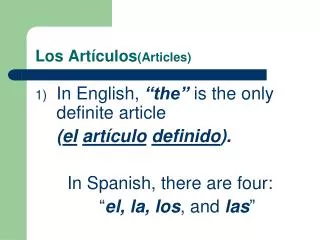
Los Artículos(Articles) • In English, “the” is the only definite article (elartículodefinido). In Spanish, there are four: “el, la, los, and las”
“el” is for masculinesingular nouns. • “los” is for masculineplural nouns
“la” is for femininesingular nouns. • “las” is for femininepluralnouns
2)In English, “a” or “an” can be an indefinite article (elartículoindefinido) In Spanish, there are four as well: “un, una, unos, and unas”
“un” is for masculinesingular nouns • “unos” is for masculineplural nouns
“una” is for femininesingular nouns • “unas” is for feminineplural nouns
Los Sustantivos (Nouns) In Spanish, all nouns (sustantivos) have either masculine or feminine gender (el genero).
Masculino 3)Nouns that refer to male beings and most nouns that end in “o” or “e” are generally masculine (masculino). (L-O-N-E-R-S) Ex: hombre, libro
Femenina 4)Nouns that refer to female beings and most nouns that end in “a”, “ión”, “tad”, or “dad” are generally feminine (femenina). (D-IÓN-Z-A) Ex: mujer, mesa, nación, libertad, and universidad
Excepciones (Exceptions) 5)There are exceptions to these rules; Some nouns appear to be masculine or feminine; however, they are not and must be memorized.
Ejemplos de Excepciones • The words “el día” and “el agua” are masculine eventhough they end in “a” • The word “la foto” is feminine eventhough it ends in “o”
Otras Excepciones The words ending in “ma” or “pa” are masculine. A good way to remember this is to say: -Ma’s and Pa’s get no La’s
Ma’s and Pa’s Ejemplos: drama, problema, programa, mapa
Making nouns plural • add “s” to words that end in vowels Ex: estudiante estudiantes
Making nouns plural • add “es” to words that end in consonants Ex: televisor televisores
Making nouns plural • change the z to a “c” to words that end in “z” Ex: luz luces