Type I errors Purcell model
This study investigates the impact of correlations between variables M and T in Purcell's moderation model. When M and T are interrelated, especially through a mediator A, the standard specification can lead to a significant increase in Type I errors. Our simulation results demonstrate that increased false positives occur in various correlation scenarios. We conclude by emphasizing the importance of fitting a bivariate moderation model first, and adhering to it if moderation on the covariance between M and T is present. Otherwise, an extended univariate approach can be more powerful.

Type I errors Purcell model
E N D
Presentation Transcript
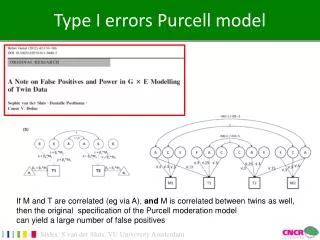
Type I errors Purcell model If M and T are correlated (eg via A), and M is correlated between twins as well, then the original specification of the Purcell moderation model can yield a large number of false positives Slides: S van der Sluis, VU University Amsterdam
Results simulation study type I error M and T correlated via A Type I increased for Ba and Bc M and T correlated via C Type I increased for Ba and Bc M and T correlated via E Type I increased for Ba, Bc and Be Slides: S van der Sluis, VU University Amsterdam
Extension means model Original model Extension means model Slides: S van der Sluis, VU University Amsterdam
Unless… Unless the covariance between M and T is subject to moderation as well. Then the univariate parameterization should not be used (again increased false positive rate) Slides: S van der Sluis, VU University Amsterdam
Conclusion • Always first fit the bivariate • moderation model. • 2. If moderation on covariance M and T is present: • stick to bivariate moderation model • 3. If moderation on covariance M and T is absent: • proceed with extended univariate parameterization (more powerful!) Slides: S van der Sluis, VU University Amsterdam