Physics Exam Problems on Optics, Buoyancy, and Thermodynamics
This document contains a variety of physics exam problems focusing on optics, buoyancy, and thermodynamics concepts. The problems cover topics such as the behavior of mirrors, densities of materials, net torque calculations, and isothermal versus isochoric processes. Students are tasked with analyzing images formed by mirrors, computing the apparent mass of submerged objects, and applying critical formulas related to work and heat in thermodynamic cycles. The exercise aims to reinforce understanding and problem-solving skills in advanced physics.

Physics Exam Problems on Optics, Buoyancy, and Thermodynamics
E N D
Presentation Transcript
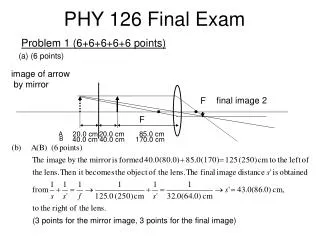
Problem 1 (6+6+6+6+6 points) PHY 126 Final Exam (a) (6 points) image of arrow by mirror final image 2 F F 20.0 cm 20.0 cm 85.0 cm A B 40.0 cm 40.0 cm 170.0 cm (3 points for the mirror image, 3 points for the final image)
(c) Real (3 point) and inverted (3 point). (d) (6 points) (e) (6 points)
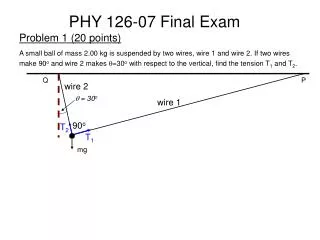
Since the density of concrete is larger than that of water, the object • is completely submerged in the water. Therefore the apparent mass • of the object is: (5 points) As the net torque around the pivot is zero: (5 points) (5 points) A: B: Problem 2 (15+15 points) (b) Since the density of ice is smaller than that of water, the object floats. Therefore there is no weight contribution from the ice object. (5 points) As the net torque around the pivot is zero: (5 points) (5 points) A: B:
ab: For isothermal process DT=0 and DU=0. W=nRTCln(Vb/Va)=-nRTCln(r) and • Q=W=-nRTCln(r). (1 point for each quantity) (b) bc: For isochoric process, DV=0 and W=0; Q=DU=nCV(TH-TC). (1 point for each) • (c) cd: For isothermal process DT=0 and DU=0. W=nRTHln(Va/Vb)=nRTHln(r) and • Q=W=nRTHln(r). (1 point for each) (d) da: For isochoric process, DV=0 and W=0; Q=DU=nCV(TC-TH). (1 point for each) (e) The net work for one cycle is Wnet=nR(TH-TC)ln(r). (4 points) Problem 3 (3+3+3+3+4+4+10 points) (f) The net heat added for one cycle Qadded is the same as Qcd=nRTHln(r). (4 points). (e) The efficiency is Wnet/Qadded=1-(TC/TH) (5 points). This is the same as the efficiency of a Carnot cycle engine operating between the two temperatures (5 points).