Download
1 / 11
110 likes | 211 Vues
This paper explores the significant dynamical effects of self-generated magnetic fields in cosmic ray modified shocks, especially in young Supernova Remnants (SNRs) like Tycho and SN 1006. It discusses key concepts such as magnetic field amplification (MFA) through various instability mechanisms, the impacts on cosmic ray spectrum characteristics, and the role of resonant and non-resonant processes. The findings suggest that magnetic feedback is crucial for understanding cosmic ray dynamics, spectral shapes, and the energy conversion processes in these astrophysical environments.

E N D
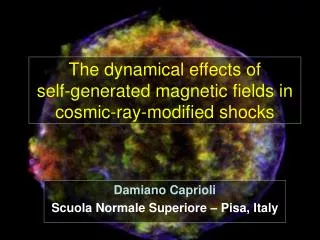
The dynamical effects of self-generated magnetic fields in cosmic-ray-modified shocks Damiano Caprioli Scuola Normale Superiore – Pisa, Italy Krakow 2008
Tycho Tycho Warren et al. 2005 SN 1006 X-ray observations of young SNRs • Bright narrow rims at the blast wave • Non-thermal spectra • Synchrotron radiationby electrons up to 10-100 TeV Krakow 2008
240¹G 240¹G 360¹G 360¹G 240¹G 240¹G 360¹G 360¹G VBK 2005 VBK 2005 Magnetic field amplification (MFA) • The width of the rims requires Bds» 90-500¹G À B0 • Völk, Berezhko & Ksenofontov 2005 • Parizot et al. 2006 • Lower Bds if the thickness of the rims were due to magnetic field damping • Pohl et al. 2005 Krakow 2008
MFA models • Cosmic ray induced Streaming Instability (SI) • Resonant(standard) Skilling 1975, Bell 1978 • Non-resonantBell 2004, Amato & Blasi 2008 • Phenomenological models: isotropization of magnetic irregularities with opposite helicities • Bell & Lucek 2001; Vladimirov, Ellison & Bykov 2007 • Amplification of the magnetic field downstream due to upstream clumpiness and shock corrugation • Giacalone & Jokipii 2007 Krakow 2008
Velocity Profile Subshock Precursor Blasi, Amato & DC 2007 Self-generatedD(x,p) Bohm diffusion in B0 Amato & Blasi 2006 The SNR paradigm for galactic CR • 10-20% of SN kinetic energy converted in CR • The upstream fluid is slowed down: CRmodified shock • Power law spectra • In modified shocks becomes rather concave • Energies up to the knee Eknee»3£106 GeV achievable only with MFA • Blasi, Amato, CD 2007 Krakow 2008
SNR Hydrodynamics • Relative positions of forward shock and contact discontinuity • Tycho, Warren et al. 2005; • SN 1006, Cassam-Chenaï et al. 2007. • Multiwavelength analysis • Berezhko & Voelk 2004 and following; • Barely consistent with predictions of Rtot / M03/4¼ 10-100 • Berezhko & Ellison 1999; Amato & Blasi 2006 • Non-adiabatic heating in the precursor? • Alfvén heating: McKenzie & Völk 1982 • Acoustic instability: Wagner et al. 2007 Ellison et al. 2007 Ellison et al. 2007 Rtot» 6-10 Krakow 2008
The dynamical feedback of MFA • Three-fluid model (plasma-cosmic rays-magnetic field) • Resonant Alfvén waves excited by standard SI • At the subshock: • Wave reflection and trasmission; Scholer-Belcher 1971 • Magnetized jump conditions;Vainio-Schlickeiser 1999 • Conservation of mass, momentum and energy lead to which is the standard one a part from the factor ¤B Ratio between magnetic and plasma pressure upstream CD et al. 2008, ApJL Krakow 2008
Normalized magnetic pressure downstream Pw,ds» 2 - 4% imply at leastW ¸ 0.3 TypicallyW»1-100 The magnetic field can not be neglected! Relevant reduction of Rtot The effect is driven by: Unmagnetized case Magnetization of SNRs DC et al. 2008, ApJL Krakow 2008
The kinetic calculation Fluid velocity CR Spectrum CR pressure Spectral slope B0=10¹G; Age of SNR=1000yr DC et al., sbt. to MNRAS Bohm diffusion in the self-generated magentic field Krakow 2008
Turbulent (Alfvén) Heating • Often invoked in order to smooth the precursor, BUT it: • Is relevant only if Vsh¿ 4000 T51/2 km/s; Völk & McKenzie 1981; Ptuskin & Zirakasvhili 2005 • Cannot be too efficient, otherwise no MFA • Has no severe effects on the precursor; DC et al. 2008;Vladimirov, Bykov & Ellison 2008 ³< 1 DC et al. 2008,sbt. to MNRAS B0=10¹G; Age=1000yr; T0=105 K Krakow 2008
Conclusions • The magnetic feedback is always relevant for young SNRs • The inclusion of the amplified magnetic field provides • A smoothening of the precursor (Rtot» 6-10) • Mildly-concave spectra (/p-3.5 at highest momenta) • Higher pmax • No dependence on M0 • Higher temperature and pressure downstream • No need for turbulent heating • The details can be analytically worked out only for resonant SI • Need for a theory of non-resonant turbulence • CR transport equation / pressure and energy densities Krakow 2008