Advancements in Agribusiness: Crop Specialization & Cattle Industry Evolution
This overview explores the evolution of agribusiness in the U.S., focusing on crop specialization and the cattle industry from the late 19th century. The North thrived with vegetables, fruits, and dairy, while the South predominantly cultivated cotton. Technological advances like the McCormick reaper revolutionized farming on larger, specialized farms. Increased production and land availability were fueled by the railroads and government initiatives, leading to the expansion of ranching and fencing practices that permanently altered the landscape of agriculture.

Advancements in Agribusiness: Crop Specialization & Cattle Industry Evolution
E N D
Presentation Transcript
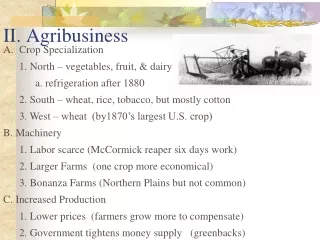
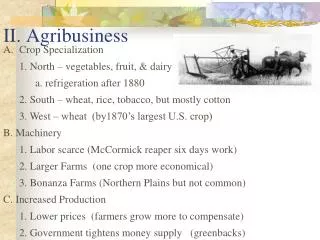
II. Agribusiness • Crop Specialization • 1. North – vegetables, fruit, & dairy • a. refrigeration after 1880 • 2. South – wheat, rice, tobacco, but mostly cotton • 3. West – wheat (by1870’s largest U.S. crop) • B. Machinery • 1. Labor scarce (McCormick reaper six days work) • 2. Larger Farms (one crop more economical) • 3. Bonanza Farms (Northern Plains but not common) • C. Increased Production • 1. Lower prices (farmers grow more to compensate) • 2. Government tightens money supply (greenbacks)
2 a. higher interest rates D. More land available 1. Railroads have to sell land a. 1st Transcontinental finished in 1869 b. publicity and boosterism in 1880s 2. Joseph Gliden invents barbed wire in 1874 3. Windmill pumps open up semiarid plains 4. Catalogues allow purchases in rural areas 5. Homestead Act opened 160 acre farms a. 5 yrs & improvements = free land b. 6 mo. & imporvement =$1.25 an acre
3 6. Great Plains boom in 1870s bust in 1880s a. weather change wet in 1870s normal dry in 1880s b. several go broke & leave area E. Cattle Industry 1. Spanish heritage from Missions 2. 1st expanse after gold rush 1849 3. Texas Cattle cut off during a. Railroads bring cattle to northern markets b.Western Cattle Trail to Union Pacific at Ogallala, NE i. later Dodge City, KA c.Goodnight Loving Trail toA.T.& S.Fe in Pueblo, CO d.Chisholm Trail to Kansas Pacific in Abilene, KA 4. Farmers start to Fence range with barbed wire 1880s
4 a. End of Open range b. Ranchers start overgrazing limited land c. fight among selves & farmers i.Lincoln County Wars in New Mexico a. Billy the Kid d. Winter of 1885-6 most sever in history i. 90% of all cattle in U.S. die ii. New breeds introduced for limited space iii. More beef per hoof but not as hearty