Download
1 / 17
170 likes | 287 Vues
The COAT-AIJA 2004 Model Practice Guide offers a thorough overview of tribunal processes aimed at enhancing competence and best practices. This manual encompasses principles of tribunal operations, jurisdiction-specific guidelines, and personal notes for members. It serves as a practical resource for members, emphasizing accessible explanations, checklists, and references to primary materials. The structured approach ensures that it meets diverse tribunal needs and supports continuous professional development, making it an invaluable tool for tribunal practitioners.

E N D
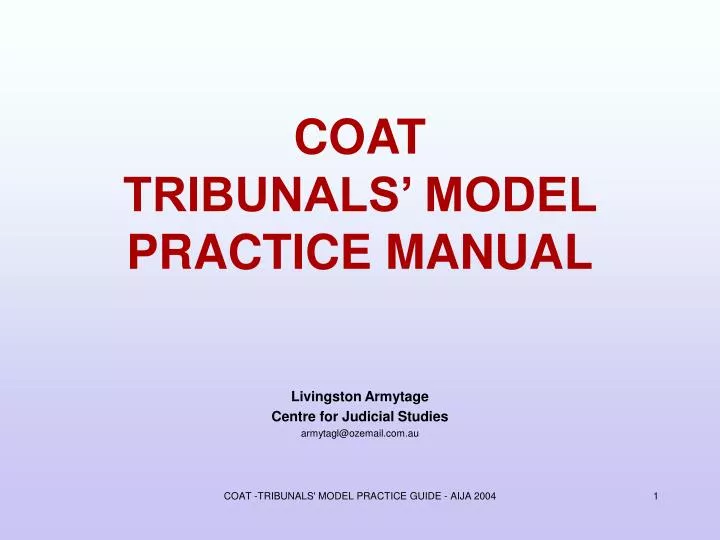
COAT TRIBUNALS’ MODEL PRACTICE MANUAL Livingston Armytage Centre for Judicial Studies armytagl@ozemail.com.au COAT -TRIBUNALS' MODEL PRACTICE GUIDE - AIJA 2004
OVERVIEW • Consultative process • COAT/AIJA Conference June 2003 • Members’ Workshops April 2004 • AAT National Needs Assessment • Tribunal models • Literature survey COAT -TRIBUNALS' MODEL PRACTICE GUIDE - AIJA 2004
RECOMMENDATION • COAT publishes Tribunals’ Model Practice Manual COAT -TRIBUNALS' MODEL PRACTICE GUIDE - AIJA 2004
AIM • Benchmark of competence and best practice • One-size-fits-all approach • Induction and continuing professional development needs • Law and other-trained members COAT -TRIBUNALS' MODEL PRACTICE GUIDE - AIJA 2004
“How to do it” guide • Stand-alone • Members may not have access to ancillary training and professional development resources • Not a legal monograph, text book, encyclopedia, or members terms-and-conditions manual COAT -TRIBUNALS' MODEL PRACTICE GUIDE - AIJA 2004
STRUCTURE Three parts: • Generic principles of tribunal processes – COAT • Jurisdiction specific applications for each tribunal – each tribunal • Personal notes – each member COAT -TRIBUNALS' MODEL PRACTICE GUIDE - AIJA 2004
CONTENT • Content of Part A as outlined in the table of contents COAT -TRIBUNALS' MODEL PRACTICE GUIDE - AIJA 2004
PART A – PRINCIPLES OF TRIBUNAL PROCESSES 1 Nature of Tribunals 2 Legal Framework 3 Principles of Tribunal Processes 4 Pre-hearing 5 Hearings COAT -TRIBUNALS' MODEL PRACTICE GUIDE - AIJA 2004
PART A – PRINCIPLES OF TRIBUNAL PROCESSES 6 Decision-making 7 Post-hearing 8 Communication 9 Case-flow Management 10 Conduct 11 References COAT -TRIBUNALS' MODEL PRACTICE GUIDE - AIJA 2004
PART B JURISDICTIONAL GUIDE • Jurisdiction, powers and functions of tribunal • Extracts of key statutes, regulations, rules • Selected case law, major decisions, commentaries, references COAT -TRIBUNALS' MODEL PRACTICE GUIDE - AIJA 2004
Guidelines to common and/or difficult applications • Hearing procedure checklists • Template forms, decisions and orders • Library resources, tables, bulletins COAT -TRIBUNALS' MODEL PRACTICE GUIDE - AIJA 2004
PART C PERSONAL NOTES • Selected precedents • Guidelines • Updates • Notes COAT -TRIBUNALS' MODEL PRACTICE GUIDE - AIJA 2004
APPROACH AND STYLE • Succinct comprehensive overview of law and procedure • Readily-accessible, practical explanations of “what to do and how to do it” • Checklists and references to primary resources • Written in plain language COAT -TRIBUNALS' MODEL PRACTICE GUIDE - AIJA 2004
MODELS Build on existing tribunal materials: • Social Security Appeals Tribunal Members’ Handbook • Workers Compensation Commission (NSW) Arbitrator’s Manual • VCAT • Others COAT -TRIBUNALS' MODEL PRACTICE GUIDE - AIJA 2004
PRODUCTION • COAT Publication Sub-Committee • Writer – Tribunal expert • Editor • Production schedule • Soft and hard editions • Cost-recovery strategy • Train-the-trainer workshop(s) COAT -TRIBUNALS' MODEL PRACTICE GUIDE - AIJA 2004
OTHER RECOMMENDATIONS FOR COAT 1. Assessment of tribunals: • Eligible organizations • Jurisdictions and roles • Composition of membership COAT -TRIBUNALS' MODEL PRACTICE GUIDE - AIJA 2004
2. Professional development program • Conduct training needs assessment • Develop targeted training strategy with priorities • Providetrain-the-trainer course(s) COAT -TRIBUNALS' MODEL PRACTICE GUIDE - AIJA 2004