Understanding Cancer
170 likes | 323 Vues
Cancer is a complex group of over 100 diseases characterized by uncontrolled cell division. It ranks as the second leading cause of death in the US, with different types varying in growth rates and treatment approaches. Over 2,300 years ago, Hippocrates likened tumors to crab limbs, giving rise to the term "cancer." The development includes stages from mutation to metastatic spread. Statistics indicate men have a 1 in 2 lifetime risk, while women have a 1 in 3 risk. Early detection significantly improves survival rates. Prevention is achievable through individual behavior changes and public health interventions.


Understanding Cancer
E N D
Presentation Transcript
What is Cancer? • Cancer is a group of more than 100 diseases that develop over time • Involve the uncontrolled division of the body’s cells • Cancer is the 2nd leading cause of death in the US
What is Cancer? • More than 2,300 years ago, Hippocrates observed that the veins off of some breast tumors looked like limbs of a crab so the Latin word for crab was eventually used for all tumors
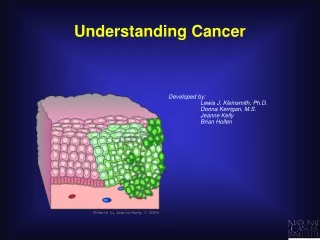
What is Cancer? • Tumor: mass of cells • May remain within the tissue in which it originated (in situ or benign cancer) • May begin to invade nearby tissues (invasive or malignant cancer) • Cells can move through the blood or lymph system and create tumors elsewhere in the body (metastatic cancer)
What is Cancer? • Stages of tumor development: • Mutation • Hyperplasia • Dysplasia • In situ cancer (benign tumor) • Invasive cancer (malignant cancer) • Cells can move through the blood or lymph system and create tumors elsewhere in the body (metastatic cancer)
What is Cancer? • The type of cancer depends on it’s location • Each type of cancer has its own growth rate, prognosis, and treatability
How Likely are You to get Cancer? • Lifetime Risk • The probability that you will develop cancer • Men have a one in two lifetime risk • Women have a one in three lifetime risk • Relative Risk • Your individual risk based on genetics and risk factors
Surviving Cancer • Incidence Rate: • The number of new cases per 100,000 people • Mortality Rate: • The number of deaths per 100,000 people per year • Survival Rate: • The proportion of patients alive at a given point after their diagnosis of cancer • The chance of surviving cancer increases with earlier detection and treatment
Cancer in Children • Cancer in children is relatively rare; only 14.1 cases per 100,000 children under the age of 15 • However, after accidents, Cancer is the second leading cause of childhood death in the US. • Leukemias and cancers of the brain and nervous system account for more than ½ the cancers among children.
Preventing Cancer • Levels of cancer prevention • Individual behavior changes is critical • Health care providers – provide both counseling and screening • National level – government regulations to minimize public exposure to known carcinogens • International level – actions of developed countries can effect the incidence of cancer worldwide