Genocide
January 27th is Holocaust Memorial Day, commemorating the liberation of Auschwitz in 1945 and the millions lost during the Holocaust. This day encourages reflection on the importance of remembering past atrocities to promote tolerance and prevent future genocides. We define genocide as the intentional extermination of racial, religious, or ethnic groups, highlighting its roots in prejudice and oppression. Educational resources are available to deepen understanding and facilitate discussions about historical and present-day genocides, fostering awareness and action in our communities.

Genocide
E N D
Presentation Transcript
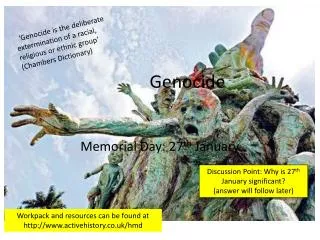
‘Genocide is the deliberate extermination of a racial, religious or ethnic group’ (Chambers Dictionary) Genocide Memorial Day: 27th January Discussion Point: Why is 27th January significant? (answer will follow later) Workpack and resources can be found at http://www.activehistory.co.uk/hmd
What is it? Why is it important? • Genocide is mass murder deliberately planned and carried out by individuals brought up to see their nationality, their race or their religion as being somehow “superior” to that of other people. • Casual prejudice, racism, grievance, intolerance, aggression, injustice and oppression all start small. • We need to spot and stop them in our own minds, families and communities before they grow and get out of control. • To do that, the way genocide becomes possible has to be understood. This means looking at the long history of genocide, as well as its symptoms in the present. • Understanding these will help to avert future horrors.
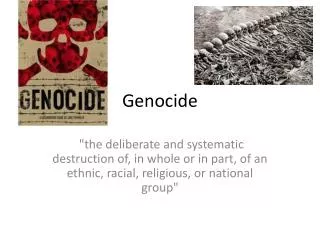
UN Definition • Article 2 of the United Nations Convention on the Prevention and Punishment of the Crime of Genocide defines it as: • Any of the following acts committed with intent to destroy, in whole or part, a national, ethnic, racial, or religious group, such as: killing members of the group; causing serious bodily or mental harm to members of the group; deliberately inflicting on the group conditions of life calculated to bring about its physical destruction in whole or part; imposing measures intended to prevent births within the group; [or] forcibly transferring children of the group to another group. Sierra Leone, 1990s: disabled people are more expensive to maintain then dead ones, so more damaging to the “enemy”
Example: the Holocaust • The Holocaust is the most infamous example of a Genocide: the deliberate attempt by the Nazis to exterminate the Jewish people. • The Nazis also attempted to exterminate other groups such as Gypsies; Homosexuals; the Disabled and other religious and ethnic minorities.
What is Holocaust Memorial Day? • Holocaust Memorial Day (HMD) was designated by the United Nations General Assembly in 2005 to commemorate the end of the Holocaust which resulted in the annihilation of 6 million European Jews and millions of others by the Nazi regime. • January 27 is the date, in 1945, when the largest Nazi death camp in Auschwitz (Poland) was liberated by Soviet troops. • HMD is now used as an opportunity to promote tolerance and understanding between races, nationalities, religions and ethnic groups.
How will we study it? • Session 1. What events in the world, your country and your family deserve to be “remembered”? • Session 2. What would be your design for a “Holocaust Memorial”? • Session 3/4. Personal Display Piece: Your own design for a memorial / evaluation of an existing one / research on a particular genocide • Session 5. Work is placed on display for the school to view and discuss Workpack and resources can be found at http://www.activehistory.co.uk/hmd