Understanding Technology's Impact on the Brain and Learning Processes
This presentation by Gamal Kalini delves into the interplay between technology and brain functioning. It emphasizes key brain areas: the brainstem for survival, cerebellum for autonomic functions, limbic system for emotions, and cortex for reasoning. The discourse includes significant principles of learning, like the Contiguity Principle, which highlights the effectiveness of pairing visuals with words. By understanding the cognitive processes involved in learning—and embracing constructivist views—we can enhance knowledge acquisition. Key references and learning styles statistics underscore the importance of tailored instructional design.

Understanding Technology's Impact on the Brain and Learning Processes
E N D
Presentation Transcript
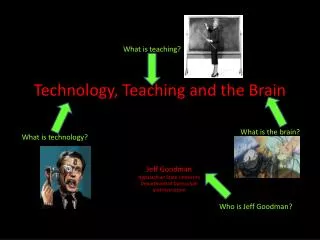
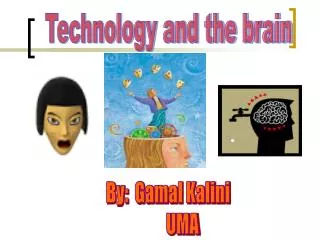
Technology and the brain By: Gamal Kalini UMA
Brainstem (survival ) • Cerebellum ( autonomic nervous system) • Limbic system (emotion) • Cortex ( reason/logic) http://www.youtube.com/watch?v=AjxJabpjDGo
Contiguity Principle • Students learn better when corresponding words and pictures are presented close to each other than far from on the page or screen. • Students learn better when corresponding words and pictures are presented simultaneously rather than consecutively.
Contiguity Principle • When combining words and graphics together in an instructional material, it is important to place the printed words near corresponding graphics. • Connection: learners make connections between graphics and text • Engagement: learners are engaging as a result of active learning • Knowledge construction: learners are constructing their knowledge as a result of being engaged
Constructivism • In the constructivist viewpoint, people build their own knowledge and their own representations of knowledge • Learning does not occur by transmitting information from the textbook to the student’s brain; instead, each student constructs his or her own personal and valid understanding of this information.
Learning • Learners have two channels for processing information: visual and auditory • Human memory has limited capacity for processing information • Information from temporary sensory memory enters working memory • Encoding is process of incorporating new knowledge with existing knowledge in long-term memory • Retrieval is process of getting knowledge from long-term memory
Association • Are used to support content • Are used to illustrate facts and concepts • Are used to show relations and construct new knowledge
Research shows: association
Learning styles According to Colin Rose, author of Accelerated learning Action Guide (1995), learning styles are visual (40-65 % of learners) and auditory (about 25-30% of learners) and the least 5 % -15%of all learners seem to be kinesthetic-tactile (Rose, 1995)
Refereces: • Clark, R. Mayer, R. (2003). E-Learning and the science of instruction: Proven guidelines forConsumers and designers of multimedia learning . San Francisco: John Wiley & Sons. • Gagne, R. M., Wager, W. W., Golas, K. C., and Keller, J. M. (2005). Principles of Instructional Design. Belmont, CA.: Wadsworth/ Thomson Learning. • Leshin, C. B., Pollock, J., & Reigeluth, C. M. (1992). Instructional Design Strategies and Tactics. Englewood Cliffs, NJ: Education Technology Publications. • http://www.youtube.com/watch?v=AjxJabpjDGo reterieved on may2008