Download
1 / 17
170 likes | 281 Vues
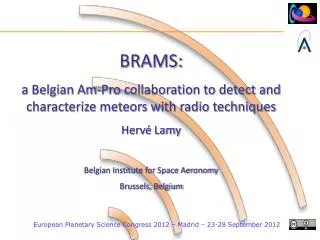
BRAMS, a Belgian-Am-Pro collaboration, utilizes radio techniques to detect and characterize meteors, providing free access to data and real-time observations. Amateurs play a crucial role in hosting stations, saving data, and supporting electricity bills. Summary: BRAMS enhances meteor observation and promotes Pro-Am collaboration for mutual benefit. Website: brams.aeronomy.be

E N D
BRAMS: a Belgian Am-Pro collaboration to detect and characterize meteors with radio techniques Hervé Lamy Belgian Institute for Space Aeronomy Brussels, Belgium
BEACON • 49.97 MHz • 150 W • Right-handed circularly polarized
A typical receiving station Data are saved in audio WAV files every 5 minutes
What does BRAMS provide to amateurs? • Provide all material for free (identical in all stations) • Access to data from all stations & archive of the data • Real-time observations to show to the public • A possibility to educate the public to meteors & radio science (BISA provides posters and articles)
What do amateurs provide to BRAMS ? • Host of most of BRAMS stations • Save data locally on hard disks & make a copy on USB sticks (64 GB) sent every month to BISA for archiving • Electricity bill supported by BRAMS participants • Multi-stations observations allowing to retrieve meteor trajectories • Participation to some projects (e.g. automatic detection of meteors in spectrograms)
Summary • BRAMS is a new tool to observe & characterize meteors • It is the result of an active Pro-Am collaboration with mutual benefit • In the future BRAMS should be extended outside of Belgium as meteors do know anything about frontiers …
Website brams.aeronomy.be THANKS !