Download
1 / 4
40 likes | 173 Vues
This paper explores the intricacies of concept mapping through the lens of architectural metaphors, highlighting common pitfalls such as default software settings and the significance of argument flow. It examines how linguistic structures, particularly between English and Japanese, influence metaphor comprehension and mapping techniques. The study illustrates the contrast between right-branching and left-branching languages, revealing how this affects information processing and representation in concept maps. A deeper understanding of these issues can enhance the effectiveness of conceptual tools.

E N D
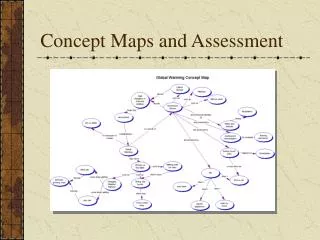
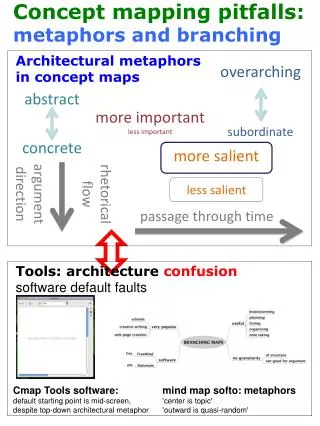
Concept mapping pitfalls: metaphors and branching overarching Architectural metaphors in concept maps abstract subordinate more important less important concrete more salient argument direction rhetorical flow less salient passage through time Tools: architecture confusion software default faults double-click to create a concept Cmap Tools software: default starting point is mid-screen, despite top-down architectural metaphor mind map softo: metaphors 'center is topic' 'outward is quasi-random'
Lawrie Hunter Kochi University of Technology http://lawriehunter.com Priming in metaphor comprehension Japanese is a between-the-lines language: priming effects are derived from syntactic factors. In Japanese: > Base-primed metaphor processing Target- primed metaphor processing fast Kurosawa, M., & Kawahara,T. (1999). Alignment or Abstraction? Metaphor comprehension in Japanese. Proceedings, Second International Conference on Cognitive Science. http://www.jcss.gr.jp/iccs99OLP/p3-19/p3-19.htm (inverted form of metaphor) !! discontinuity In English: Gentner and Wolff (1997): primacy of abstractionfactors in metaphor comprehension in English, a specificity-oriented language. . Gentner,D., & Wolff, P. (1997). Alignment in the processing of metaphor. Journal of Memory and Language, 37, 331--355
Branching in syntax Right-branching Yesterday I 1 went 2 to the DIY 3 to get 4 a screwdriver 5 to repair 6 my glasses 7 Left-branching 昨日、眼鏡7を直す6ためのドライバー5を買い4にホームセンター3に行きました2。 Kinou, megane 7 wo naosu 6 tame no doraibaa 5 wo kai 4 ni houmu sentaa 3 ni ikimashita 2. In English clause semantic completeness is the primary processing unit in initial segmentation Japanese is a left-branching language Clause semantic completeness is not the primary processing unit in initial segmentation Sentential Japanese has delayed reveal of significand. Mazuka, R. (1998) The development of language strategies: a cross-linguistic study between Japanese and English. Erlbaum. Branching in mapping software -in mind maps: radial, random -in Novakian maps: top down, articulate, nodes sentences or nouns -in CmapTools: Novakian, default radial -in RST tool: bottom up (conceptually), nodes tend to be sentences.
Western Visual Design Grammar: English mixed media layout signifies relationships in two ways: New Mediator Given Left to right images/texts are GIVEN, Mediator and NEW Top to bottom images/texts are IDEAL, Mediator and REAL. Ideal • Systemic Functional Linguistics says that rhetoric hinges on • GIVEN, • what the listener/reader already knows, and • NEW, • what the speaker/writer is going to 'break.' • Halliday, M.A.K. (1985) An introduction to functional grammar. • London: Edward Arnold • -Japanese rhetoric • doesn't do things that way. Mediator Real Kress, G. and van Leeuwen, T. (1996) Reading images: The grammar of visual design. Routledge. Japanese media/graphic arts don't do things that way. Japanese Visual Design Grammar: Japanese Visual Language: The Structure of Manga. Neil Cohn. http://www.emaki.net/essays/japanese_vl.pdf