Uno played using multiplication or division.
Transform the classic game of UNO into an interactive learning experience that enhances students' multiplication and division skills! Players must solve multiplication problems to place their cards, reinforcing math concepts in a fun, social environment. With adaptations for various learning levels, such as using multiplication charts, calculators, or advanced challenges for higher learners, this game caters to all abilities. The excitement of UNO combined with educational rigor makes math practice enjoyable and effective!

Uno played using multiplication or division.
E N D
Presentation Transcript
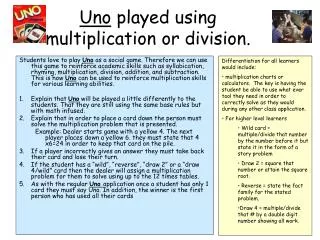
Uno played using multiplication or division. Students love to play Uno as a social game. Therefore we can use this game to reinforce academic skills such as syllabication, rhyming, multiplication, division, addition, and subtraction. This is how Uno can be used to reinforce multiplication skills for various learning abilities. • Explain that Uno will be played a little differently to the students. That they are still using the same base rules but with math infused. • Explain that in order to place a card down the person must solve the multiplication problem that is presented. Example: Dealer starts game with a yellow 4. The next player places down a yellow 6. they must state that 4 x6=24 in order to keep that card on the pile. • If a player incorrectly gives an answer they must take back their card and lose their turn. • If the student has a “wild”, “reverse”, “draw 2” or a “draw 4/wild” card then the dealer will assign a multiplication problem for them to solve using up to the 12 times tables. • As with the regular Uno application once a student has only 1 card they must say Uno. In addition, the winner is the first person who has used all their cards. • Differentiation for all learners would include: • multiplication charts or calculators. The key is having the student be able to use what ever tool they need in order to correctly solve as they would during any other class application. • For higher level learners • Wild card = multiple/divide that number by the number before it but state it in the form of a story problem • Draw 2 = square that number or attain the square root. • Reverse = state the fact family for the stated problem. • Draw 4 = multiple/divide that # by a double digit number showing all work.