Download

1 / 19
190 likes | 302 Vues
This presentation by Menzie D. Chinn from the University of Wisconsin and NBER explores the concept of a "global saving glut" and its potential connection to the US current account deficit. It discusses the inconsistencies present in long-term real rates and examines regional surpluses, particularly in East Asia. With a focus on econometric analysis from 1971 to 2004, the presentation questions whether the US deficit is too large, considering the significant shifts in budget and current account balances in the early 2000s. Financial development's role in alleviating these imbalances is also evaluated.

E N D
Is There a “Global Saving Glut”?And Is It the Cause of the US Current Account Deficit? Menzie D.Chinn University of Wisconsin and NBER Presentation at NABE Panel “International Capital Flows” ASSA, Chicago, January 6, 2007
Anticipating the Answers • Maybe (better investment drought) • Maybe
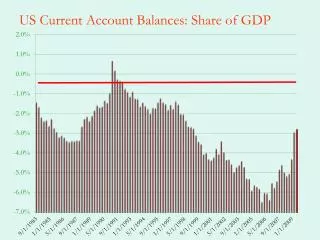
Too Obvious a Question? • Long term real rates are low • The U.S. CA deficit seems anomalously large • The East Asian surpluses appear anomalously large
Are Real Long Term Rates and the CA Moving Together? Note: 10 yr const. mat adjusted by Livingstone, Blue Chip, SPF 10 year expected infl.
US Long Term Real Rates Source: St. Louis Fed, Philadelphia Fed
World Real RatesInflation indexed Source: BIS, St. Louis Fed
Is the US Deficit Too Large? • Panel regression approach • 1971-2004, 21 industrial, 97 developing countries (WDI), in five year panels • Include time fixed effects • X are macro variables • Z are financial development, institutional variables (credit; law & order) Source: M.Chinn & H. Ito, “Assaying the World Saving Glut”,http://www.ssc.wisc.edu/~mchinn/CA_Chinn_Ito.pdf
Is the US Deficit Too Large? • Short answer: Barely, according to statistical level • Budget deficit is important
Reality Check Between 2000 and 2005, there was approximately a 4.3 percentage point swing in the US Federal budget balance, and a 2.2 percentage point swing in the U.S. current account balance. This outcome is consistent with a 0.5 coefficient.
NSUS’ REAsia NSEAsia RUS IUS IEAsia NSUS R0 R1 CA1EAsia > 0 CA1US < 0 How Can Low Rates and Imbalances Be Reconciled?
Ending Thoughts • Most of the debate has been cast in identities, or simple bivariate relationships • Chinn-Ito quantify the uncertainty surrounding the CA balance relationship • There is something to the saving glut story • But there is also a role for budget deficits • Financial development may or may not help reduce the saving glut