Understanding Two-Dimensional Array Initialization and Processing in Programming
This guide provides a comprehensive overview of two-dimensional arrays, detailing the methods for their declaration, initialization, and processing in programming, particularly in languages such as Fortran. It covers explicit and implicit type declarations, assignment statements, and reading from input sources. Examples include creating identity matrices, reading elements column-wise, and iterating through arrays both row-wise and column-wise. The document offers practical solutions that demonstrate how to manipulate two-dimensional arrays effectively, making it an essential resource for learners and professionals alike.

Understanding Two-Dimensional Array Initialization and Processing in Programming
E N D
Presentation Transcript
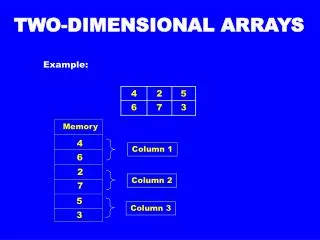
Memory 4 6 Column 1 2 7 Column 2 5 3 Column 3 TWO-DIMENSIONAL ARRAYS Example:
Two Dimensional Array Declaration Explicit type declaration INTEGER ID(3, 3) REAL MSR(100, 100), Z(4:7, 8) CHARACTER WORD(5, 5)*3 LOGICAL TF(5, 7) Implicit type declaration DIMENSION ALIST(10, 5), KIT(-3:5, 6), XYZ(15, 4) INTEGER XYZ REAL BLIST(7, 8), KIT
Two Dimensional Array Initialization • processing the array column-wise - process the 1st column, then the 2nd column , - - - • processing the array row-wise - process the 1st row, then the 2nd row , - - - Initialization Using the Assignment Statement Initialization Using the READ Statement
Two Dimensional Array Initialization Initialization Using the Assignment Statement • Example 1: • Declare an integer array ID consisting of 3 rows and 3 columns • and initialize array ID row-wise as an identity matrix (i.e. all • elements of the main diagonal must be 1 and the rest of the • elements must be 0). • Solution: • INTEGER ID(3, 3), ROW, COL • C INITIALIZING ROW-WISE • DO 5 ROW = 1, 3 • DO 5 COL = 1, 3 • IF (ROW .EQ. COL) THEN • ID(ROW, COL) = 1 • ELSE • ID(ROW, COL) = 0 • ENDIF • 5 CONTINUE
Two Dimensional Array Initialization Initialization Using the Assignment Statement Example 2: Declare a real array X consisting of 2 rows and 3 columns and initialize array X column-wise. Each element of array X should be initialized to its row number. Solution: REAL X(2, 3) INTEGER J, K C INITIALIZING COLUMN-WISE DO 5 J = 1, 3 DO 5 K = 1, 2 X(K, J) = K 5 CONTINUE
Two Dimensional Array Initialization Initialization Using the READ Statement • Example 1: Read all the elements of an integer array MATRIX of size 3X3 • column-wise The input data is given as follows: • 3 4 8 • 5 9 2 • 1 6 0 • The contents of array MATRIX after reading the input data is as follows: • 5 1 • 9 6 • 8 2 0 • Solution 1: (Without Array Subscripts) • INTEGER MATRIX(3, 3) • C READING COLUMN-WISE • READ*, MATRIX
Two Dimensional Array Initialization Initialization Using the READ Statement Solution 2: (Using Implied Loops) INTEGER MATRIX(3, 3), J, K C READING COLUMN-WISE READ*, ((MATRIX(K, J), K = 1, 3), J = 1, 3) Solution 3: (Using DO and Implied Loop) INTEGER MATRIX(3, 3), J, K C READING COLUMN-WISE DO 28 J = 1, 3 READ*, (MATRIX(K, J), K = 1, 3) 28 CONTINUE
Printing Two-Dimensional Arrays Example: Read a 3X3 integer array WHT column-wise and print: i. the entire array row-wise in one line; ii. the entire array column-wise in one line; iii. one row per line; iv. one column per line; v. the sum of column 3; If the input is as follows: 5, 2 , 0 3 , 1 , 8 4 , 6 , 7 The contents of WHT after reading are as follows: 5 3 4 2 1 6 0 8 7
Solution: • INTEGER WHT(3, 3), SUM, J, K • READ*, WHT • PRINT*, 'PRINTING THE ENTIRE ARRAY ROW-WISE' • PRINT*, ((WHT(K, J), J = 1, 3), K = 1, 3) • PRINT*, 'PRINTING THE ENTIRE ARRAY COLUMN-WISE' • PRINT*, WHT • PRINT*, 'PRINTING ONE ROW PER LINE' • DO 35 K = 1, 3 • PRINT*, (WHT(K, J), J = 1, 3) • 35 CONTINUE • PRINT*, 'PRINTING ONE COLUMN PER LINE' • DO 45 J = 1, 3 • PRINT*, (WHT(K, J), K = 1, 3) • 45 CONTINUE • SUM = 0 • DO 55 K = 1, 3 • SUM = SUM + WHT(K, 3) • CONTINUE • PRINT*, 'SUM OF COLUMN 3 IS', SUM • END
The output of the program is as follows : PRINTING THE ENTIRE ARRAY ROW-WISE 5 3 4 2 1 6 0 8 7 PRINTING THE ENTIRE ARRAY COLUMN-WISE 5 2 0 3 1 8 4 6 7 PRINTING ONE ROW PER LINE 5 3 4 2 1 6 0 8 7 PRINTING ONE COLUMN PER LINE 5 2 0 3 1 8 4 6 7 SUM OF COLUMN 3 IS 17
Example: • Write a FORTRAN program that reads a two-dimensional array of size 3X3 • row-wise. The program finds the minimum element in the array and changes • each element of the array by subtracting the minimum from each element. • Print the updated array row-wise in one output line. • Solution: • INTEGER A(3, 3), MIN, J, K • READ*, ((A(K, J), J = 1, 3), K = 1, 3) • MIN = A(1, 1) • DO 3 K = 1, 3 • DO 3 J = 1, 3 • IF (A(K, J) .LT. MIN) THEN • MIN = A(K, J) • ENDIF • 3 CONTINUE • DO 4 K = 1, 3 • DO 4 J = 1, 3 • A(K, J) = A(K, J) - MIN • 4 CONTINUE • PRINT*, ((A(K, J), J = 1, 3), K = 1, 3) • END
Two-Dimensional Arrays and Subprograms • Example 1: Counting Zero Elements: Read a 3X2 integer array MAT • row-wise. Using a function COUNT, count the number of elements in • MAT with the value equal to 0. • Solution: • C MAIN PROGRAM • INTEGER MAT(3, 2), COUNT, J, K • C READING ARRAY MAT ROW-WISE • READ*, ((MAT(K, J), J = 1, 2), K = 1, 3) • PRINT*, 'COUNT OF ELEMENTS WITH VALUE 0 IS', COUNT (MAT) • END • C FUNCTION SUBPROGRAM • INTEGER FUNCTION COUNT(MAT) • INTEGER MAT(3, 2), J, K • COUNT = 0 • DO 77 K = 1, 3 • DO 77 J = 1, 2 • IF(MAT(K, J) .EQ. 0) COUNT = COUNT + 1 • 77 CONTINUE • RETURN • END
B A C
Two-Dimensional Arrays and Subprograms • Example 2: Addition of Matrices: Write a subroutine CALC(A, B, C, N) that • receives 2 two-dimensional arrays A and B of size 10X10. It returns the result • of adding the two arrays (matrices) in another array C of the same size. • Solution: • C SUBROUTINE SUBPROGRAM • SUBROUTINE CALC(A, B, C, N) • INTEGER A(10, 10), B(10, 10), C(10, 10), N, J, K • DO 10 K = 1, N • DO 10 J = 1, N • C(K, J) = A(K, J) + B(K, J) • 10 CONTINUE • RETURN • END • C MAIN PROGRAM • INTEGER A(10, 10), B(10, 10), C(10, 10), N, J, K • READ*, N • C READING ARRAY A ROW-WISE • READ*, ((A(K, J), J = 1, N), K = 1, N) • C READING ARRAYB COLUMN-WISE • READ*, ((B(K, J), K = 1, N), J = 1, N) • CALL CALC(A, B, C, N) • DO 10 K = 1, N • PRINT*, (C(K, J), J = 1, N) • 10 CONTINUE • END
Exercises INTEGER X (3, 3), J READ*, X PRINT*, X PRINT*, (X (J, J), J = 1, 3) PRINT*, (X (J, 3), J = 1, 3) END Assume the input is: 1 5 7 7 5 1 3 8 9 The output 1 5 7 7 5 1 3 8 9 1 5 9 3 8 9
INTEGER A (3, 3), J, K READ*, ((A (K, J), K = 1, 3), J = 1, 3) PRINT*, A PRINT*, ( (A(K, J), J = 1, 2), K = 1, 3) PRINT*, A(3, 2) PRINT*, (A (K, 2), K = 3, 1, -2) END Assume the input is: 1 2 3 4 5 6 7 8 9 The output 1 2 3 4 5 6 7 8 9 1 4 2 5 3 6 6 6 4