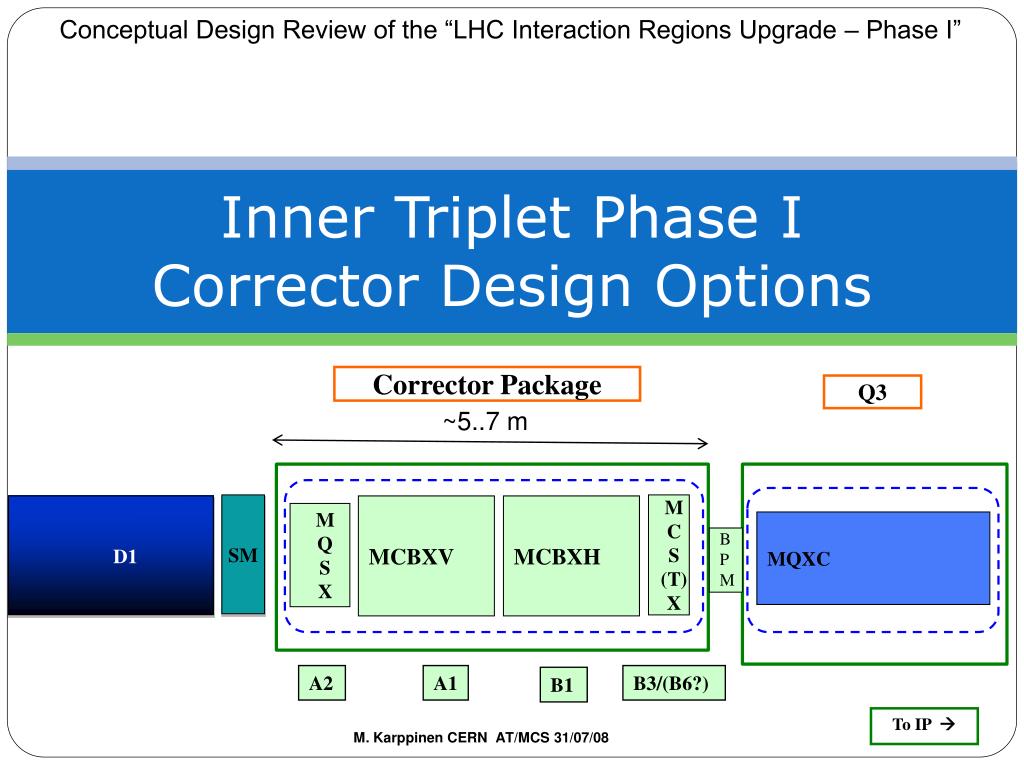
Conceptual Design Review of the “LHC Interaction Regions Upgrade – Phase I” Inner Triplet Phase I Corrector Design Options Corrector Package Q3 ~5..7 m SM M C S (T) X D1 MCBXV MCBXH M Q S X MQXC B PM A2 A1 B3/(B6?) B1 To IP M. Karppinen CERN AT/MCS 31/07/08
Acknowledgements: • STFC/RAL: E. Baynham, S. Canfer, P. Loveridge, J. Rochford • CIEMAT: F. Toral, I. Rodriguez • CERN: B. Auchmann, F. Cerrutti, G.-J. Coelingh, N. Elias, S. Fartoukh, S. Russenchsuck, N. Schwerg, T. Sahner, E. Wildner, M. Karppinen CERN AT/MCS
Outline • Corrector requirements and constraints • Some LHC corrector specific fabrication aspects • Design status: • MCBX (CERN) • MQSX (STFC/RAL & CERN) • MCSX (CIEMAT & CERN) • Summary M. Karppinen CERN AT/MCS
Requirements & Constraints • Fit all correctors in dedicated cryo-assembly within 5..7 m between Q3 and D1 • Aperture ≥ø120 mm (TBC) • Operating temperature 1.9 K • (Try to) Use existing: • Power converter • Bus-bars • Current leads • Quench detection & protection systems M. Karppinen CERN AT/MCS
Requirements.. (cont) • MCBX • correct for a triplet misalignment of 1mm • 1-1.5 Tm for generation of X-angle, parallel separation, and transverse adjustment of the IP • 6 Tm in H- and V-plane (presently 3 x 1.51/1.56 Tm) • MQSX • Compensate for triplet roll of 4 mrad • 20 Tm/m or 40 T/m x 0.5 m • MCSX • correct for b3 of D1 (29 Tm) • ~25 T/m2x 0.5 m (b3 = 6 units) • MCTX • MQX systematic b6 (1 unit) correction • MCSOX • Not yet clear, if required… Based on scaling the present triplets. New requirements not yet available M. Karppinen CERN AT/MCS
Requirements.. (cont) • Very hostile environment • Material selection (insulation, head spacers etc..) • Spare policy • “Intervention friendly” design of cryo-magnets • Radioprotection • Reliability: • MCBX must work, no redundancy • Cost • Investment on powering/cooling • Fabrication cost & spares M. Karppinen CERN AT/MCS
LHC Corrector Fabrication Aspects • Flat cable • Purpose built machine to bond 2-25 enamel (PVA) insulated wires together • Tolerance +0.02/-0.01 mm, unit lengths up to 160 m • Wires are connected in series on connection plate • Coil winding • Dipole coils with standard winding machine • Counter-winding technique used for single winding block coils • All coils epoxy impregnated in vacuum or by wet-laying • Coil lengths up to 1.5 m • Assembly • Epoxy-glass around the coils by vacuum impregnation or pre-preg • Pre-stress from shrink-fitted Alu/St.steel cylinders • Off-center laminations M. Karppinen CERN AT/MCS
Nb47%Ti PVA insulation RRR >100 Filament diameter 6-7 micrometer. Limited quantity available for model magnets Superconducting wire M. Karppinen CERN AT/MCS
Coil winding Counter-winding (MQSX) Dipole winding (MCBM) M. Karppinen CERN AT/MCS
Coil assembly M. Karppinen CERN AT/MCS
Present MCBX: Coil Fabrication M. Karppinen CERN AT/MCS
Present MCBX: Assembly M. Karppinen CERN AT/MCS
MCBX: Electrical Connections M. Karppinen CERN AT/MCS
MCBX for Phase I • From 3 nested to 2 separate H/V-steering magnets • Central field: 3 T => ~3.5 T • Total length: 0.7 m => ~2 m/unit • Aperture: ø90 mm => ø120 mm • Stored energy: 44kJ => ≥150 kJ • Field quality < 1unit @30 mm • Quench protection: none => active protection • Mechanical structure based on collared coils • First design iteration for Inom ≤600 A • Alternative high current designs based on MQY and MB cables M. Karppinen CERN AT/MCS
600 A Design wp = ~60 % on the LL 8-way cable PVA insulated wire Potted coils Each coil consists of 8 electrical circuits in series with a quench stopper in between Quench stopper between the coils Existing power converters Std. LHC QP system M. Karppinen CERN AT/MCS
MCBX: 600 A Design M. Karppinen CERN AT/MCS
MCBX: Quench analysis • Four 600 A cases analyzed at this point • Wire #4, 1.9 K, no dump resistor • Wire #4, 1.9 K, with dump resistor • Wire #4, 4.5 K, with dump resistor • Wire #3, 1.9 K, with dump resistor Additional cases to look into • Cable versions, with heaters/dump resistor • Include energy deposition from FLUKA M. Karppinen CERN AT/MCS
LHC 600 A circuit Courtesy of Gert-Jan Coelingh (AT-MEI) Design for Rd=0.7 Ω with 2 x mass available Ugnd ≤ 420 V Present Rd tested with 113 kJ (+115°C) Breaker designed for 750 A 3 spare systems available M. Karppinen CERN AT/MCS
Wire#4, 1.9 K, with Rdump Rd = 0.7 Ω (14.6 ms) Tmax = 140 K Ugnd = 400 V UR= 1100 V =>SAFE Tmax Quench origin M. Karppinen CERN AT/MCS
Wire#4, 1.9 K, with Rdump M. Karppinen CERN AT/MCS
Wire#4, 4.5 K, with Rdump Rd = 0.7 Ω (14.6 ms) Tmax = 110 K Ugnd = 350 V UR = 870 V =>SAFE Wire#3, 1,9 K, with Rdump Rd = 0.9 Ω (14.6 ms) Tmax= 250 K Ugnd = 1000 V UR = 3100 V =>RISKY M. Karppinen CERN AT/MCS
MCBX: Cable Design MB Outer Cable MQY Outer Cable x 2 Aperture easily enlarged (shielding) Much improved cooling (1.9K) Single or double layer coil (powering) Collars New power converters, cables, and leads. (Challenging around 0-current?) Active QPS (heaters/dump resistors) Can meet field quality requirements (yoke optim.) M. Karppinen CERN AT/MCS
MCBX: Cable variants MQY Outer Cable MQY Inner Cable MQY Inner Cable x 2 MQY Outer Cable x 2 M. Karppinen CERN AT/MCS
MCBX: Cable Design,1.9 K M. Karppinen CERN AT/MCS
Mechanical design: collars Courtesy of T. Sahner (TS-MME) Courtesy of N. Elias M. Karppinen CERN AT/MCS
MCBX Design status & plans • Magnetic design • X-sections for 600 A and Cable • Software development/testing • Quench analysis • 600 A versions • Cable design • FLUKA Studies • Design optimization • Mechanical design • Material selection • 2D&3D magnetic design • Model magnet (after Aug -09) • Model Test (after Sep -09) • Prototype Design & Construction (2010..) ✔ ✔ ✔ Next step Underway Underway M. Karppinen CERN AT/MCS
MCBX Summary • 600 A design based on wire #4 would allow re-using the existing powering and protection systems, but radiation & energy deposition may compromise the reliability • Cable design more robust, easier to make, makes full use of 1.9 K cooling, and offers more freedom for aperture size. Requires investment in powering and protection. • 1.9 K operation: • Extract the heat from energy deposition • More compact coils, shorter overall length • Savings in material and tooling cost • Reduced risk of fabrication failure (< 2 m, 600 A) • 1.9 K cooling is available • Decisions required (aperture, Inom, field quality) to start the detailed design and to meet the tight milestones for the project. M. Karppinen CERN AT/MCS
MQSX for Phase I • Gradient: 80 T/m => 40 T/m • Total length: 0.3 m => 0.8 m • Aperture: ø70 mm => ø120 mm • Stored energy: 4.2 kJ => ~10 kJ • Field quality < 1unit @30 mm • Quench protection: none => probably none (TBC) • Mechanical design based on the present concept • First design iteration for Inom <600 A based on wire #3 M. Karppinen CERN AT/MCS
MQSX: Present design M. Karppinen CERN AT/MCS
MQSX: Parameters M. Karppinen CERN AT/MCS
Field quality: First Estimate From S. Fartoukh • Scale measured mean MQXB to 30 mm • Scale with ß (12.5 km/4.5 km)n/2 • MQSX strength 0.004 of MQXB • To stay in the shadow allow <10 % M. Karppinen AT/MCS
Phase I MQSX M. Karppinen CERN AT/MCS
MQSX: Next steps • Moving forward with the baseline 6 wire 2 block configuration, there are a number of issues to be addressed. • Magnetically • Quench protection-should not be a problem, but needs to be confirmed • Effect of manufacturing tolerances on harmonic structure • 3d models: end effects, spacer optimisation • Mechanically • P. Loveridge has started looking at mechanical design issues and FEA • Radiation hard materials • Baseline definition • Key components • Preliminary drawings • Manufacturing costs Courtesy of James Rochford - STFC M. Karppinen CERN AT/MCS
MCSX for Phase I Courtesy of Fernando Toral (CIEMAT) M. Karppinen CERN AT/MCS
MCSX: Parameters (Draft 1) Courtesy of Fernando Toral (CIEMAT) M. Karppinen CERN AT/MCS
Summary • Verydemanding operating environment • MCBX shall have the same level of reliability as MQX (radiation hardness, cooling) • Cable design with active protection operating at 1.9 K is the most promising option • MQSX based on the present technology can meet the Phase I requirements • Super-ferric MCSX expected straight forward • Detailed design requires decision on aperture, operating current, and field quality targets M. Karppinen CERN AT/MCS