Download
1 / 11
110 likes | 236 Vues
This study explores user perspectives on multi-touch tabletop therapies designed to aid stroke rehabilitation. Following a stroke, individuals often experience a loss of upper motor ability, leading to repetitive and monotonous rehabilitation exercises. By integrating technology and gamifying movements, engagement may increase. Four tasks were executed by 14 healthy subjects, revealing that participants valued interactivity and feedback, although frustration with technology responsiveness was noted. Key takeaways include the importance of meeting user expectations and offering immediate feedback in improving therapeutic experiences.

E N D
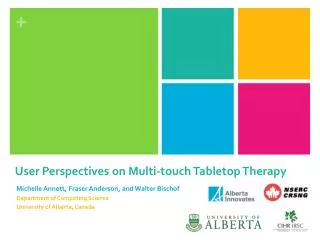
User Perspectives on Multi-touch Tabletop Therapy Michelle Annett, Fraser Anderson, and Walter Bischof Department of Computing Science University of Alberta, Canada
Stroke rehabilitation • Many people suffer loss of upper motor ability following a stroke • To regain function, therapists encourage repetitive movements to increase muscle strength, coordination, and range of motion • These activities are often monotonous and discouraging, causing patients to neglect their treatment
Technology to the rescue • In recent years, technology has been used to improve stroke rehabilitation • Gamification of repetitive movements to increase engagement • Use of technology allows customization, progress monitoring, and feedback • Previous research shows no intrinsic movement benefits to technology • Power is in enjoyment, customization
Tabletop therapy • Interactive tabletops have several benefits • Direct interaction • Large, 2D interaction space • Ergonomics (supports body weight, allows seated interaction) • Challenges • User’s expectations increase with commercial products • Direct interaction leaves little room for error
Study • 14 healthy subjects (7 male, 18-77 y) • Performed 4 tasks (2 tech, 2 traditional) • Completed questionnaire (Intrinsic Motivation Inventory) • Semi-structured interview
Questionnaire responses • Higher interest in technology • Other subjective dimensions similar
Lessons Learned I • People enjoyed: • Interactivity • Animations • Sounds • Feeling of accomplishment, competition with themselves
Lessons Learned II • User Expectations • P13 notes “if you have an iPad you can see that it registers every motion and gesture ... the design of [iPad] games are better” • And P12 is “just so used to playing those iPhone games” • Frustration and Responsiveness • P7was “irritated at how the tabletop wasn’t too responsive” • P8 “felt [they] could handle the physical materials more easily than the digital ones”
Takeaways • Provide immediate feedback on their actions • User-facing aspects cannot be ignored • Patients may already be discouraged by the nature of the activities • Small frustrations can negate many benefits of technology • User expectations will continue to increase • Older users currently not familiar with technology, but this will change, and expectations will be higher