Underlying Patterns in Talk about Relationships
60 likes | 177 Vues
This analysis delves into common metaphors used in relationships, likening dynamics to work, journeys, games, bonds, and organisms. It emphasizes the complexity of communication, highlighting how misunderstandings arise from diverse perspectives and motivations. By exploring concepts like the "game of catch" in communication and the importance of subtext, it offers insights into how language can both connect and confound individuals. Understanding these patterns can enhance relational clarity and address the roots of misinterpretations.


Underlying Patterns in Talk about Relationships
E N D
Presentation Transcript
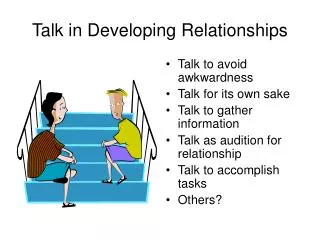
Common Metaphors for Relationships (K&V 1.4) • Relationships as: • Work, journey, game, bond, organism • What else? • Communication as: • Game of Catch (conduit metaphor) • Clues for Creating Worlds • Undercurrent or Subtext (content vs. relational)
“Because language has a common surface and private base, it is both very easy and very difficult for people to understand one another” Retzinger, S. (1991). Violent emotions. Newbury Park, CA: Sage, p. 10.
What Metaphors Avoid Misconceptions? Consistency – “But that’s not what you said yesterday.” Simple meaning – “You said it so you must have meant it.” Independence – “It wasn’t my fault.” Obvious Causality – “I know why you said that.” Finality – “I admitted it. What more do you want?”
Thoughts about Misunderstandings • Communication is incredibly complex, so misunderstandings are “understandable.” • Interpretations depend on perspectives • (A’s story, B’s story, and perhaps C’s (outsider’s)) • People make strong inferences without knowing that they have. • Seldom get feedback to correct them. • Often perspectives are not in conflict, but irrelevant to each other • Very little evidence of spontaneous, complex perspective taking
More on Misunderstandings • Motivated misunderstandings: Victims and perpetrators have different views of transgressions (severity, temporal bracketing, deliberate/impulsive intentions, cause/result, moral clarity, guilt/blame, relevance to present) • Narratives about harm had fewer references to others’ thoughts than narratives about helping • Some misunderstandings are positive – irreconcilable differences, unpleasant truths, optimism is helpful. • From Sillars, A. L. (1998). (Mis)understanding. In B. H. Spitzberg & W. R. Cupach (Eds.), The dark side of relationships (pp. 73-102). Mahwah, NJ: Erlbaum. • Baumeister, R. F., & Catanese, K. (2001). Victims and perpetrators provide discrepant accounts: Motivated cognitive distortions about interpersonal transgressions. In J. P. Forgas, K. D. Williams, & L. Wheeler (Eds.), The social mind. New York: Cambridge University Press.