Overview of the Nervous System and Neurohistology
290 likes | 395 Vues
This lecture provides a comprehensive introduction to the anatomical organization of the nervous system, outlining the Central Nervous System (CNS) and the Peripheral Nervous System (PNS). It covers the characteristics of neurons, including the cell body, dendrites, and axons, as well as details on axonal transport mechanisms. The lecture also discusses neuroglial cells, their functions, and the significance of the autonomic nervous system (ANS) subdivisions. Key terminology related to nerve pathways and structure is highlighted to aid understanding of neuroanatomy.


Overview of the Nervous System and Neurohistology
E N D
Presentation Transcript
NERVOUS SYSTEMLecture 1 OVERVIEW and NEUROHISTOLOGY
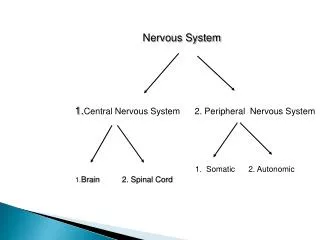
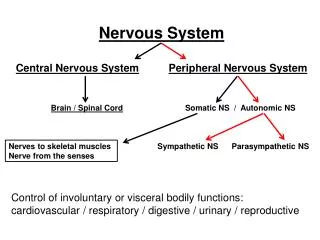
Central Nervous System (CNS) • Definition: Unpaired, bilaterally symmetrical structures extending along the longitudinal axis of the midsagittal plane of the body. Structures arising directly from the neural tube. • Includes: Brain Spinal cord
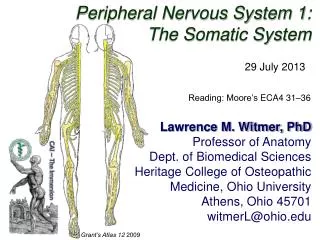
Peripheral Nervous System (PNS) • Definition: Made up of transmission pathways carrying information between the CNS and external/internal environments. • Afferent (sensory) pathways: Carry information to the CNS. • Efferent (motor) pathways: Carry information from the CNS.
Peripheral Nervous System (PNS) • Includes: Cranial nerves (12 pairs). Spinal nerves (31 pairs).
Autonomic Nervous System (ANS) • May be considered a subdivision of the PNS. • Entirely motor. • Innervates smooth muscle and glands (viscera).
ANS Subdivisions • Sympathetic system (fight or flight): Also called thoracolumbar. • Parasympathetic system (feed or breed): Also called craniosacral.
Parts of a Neuron • Cell body: Trophic unit Perikaryon • Dendrites: Receptive unit • Axon: Conductive unit
Cell Body Definition • That part of a neuron that encloses the nucleus and other organelles necessary to maintain and repair the neuron.
Cell Body Organelles • Nucleus • Golgi apparatus • RER Ribosomes (=Nissl substance)
Dendrites (Characteristics) • Branches off the cell body that carry information to the cell body. • Usually several to many. • Relatively short. • Often branched. • Have receptors for neurotransmitters. • Conduct local potentials.
Axon Characteristics • Carries information to another neuron or muscle cell. • Often relatively long. • Single (one per neuron). • Conducts action potential
Axon Characteristics • Ends in short branched processes called telodendria. • May have collateral branches. • Cell membrane (= axolemma). • Cytoplasm = (axoplasm).
Axon Characteristics • Covered by neurolemma: Made up of Schwann cells. • Often myelinated: Myelin is formed by Schwann cells. • Note: axon is the only part of a neuron that is ever myelinated.
Axon Organelles • Mitochondria • Neurofilaments • Neurotubules
Axonal Transport • Anterograde: Transports vesicles from cell body to end of axon. Kinesin • Retrograde: Transports vesicles from end of axon toward cell body. Cytoplasmic dynein
Axonal Transport • Slow transport: 1-5 mm/day • Fast transport: 200-400 mm/day
General Terminology • Nerve: Bundle of fibers in the PNS. • Tract: Bundle of fibers in the CNS. • Commissure: Tract in the CNS that crosses from one side to the other.
General Terminology • Nucleus: Aggregation of dendrites and nerve cell bodies in the CNS. • Ganglion: Aggregation of dendrites and nerve cell bodies in the PNS.
General Terminology • White matter: Areas of myelinated axons. • Gray matter: Areas of unmyelinated axons, cell bodies, and dendrites.
Synapse • Definition: • Composite structure that allows two neurons or a neuron and a muscle cell to “talk” to each other.
Synapse Components • Presynaptic membrane: With synaptic vesicles filled with neurotransmitters. • Synaptic cleft: • Postsynaptic membrane: With receptors for neurotransmitters. • Monosynaptic pathways. • Polysynaptic pathways.
Reflex Arc • Afferent (sensory) pathways: Somatic. Visceral (splanchnic). • Efferent (motor) pathways: Somatic. Visceral (splanchnic). • Association neurons (interneurons).
Neuroglial Cells • Schwann cells • Astrocytes • Microglial cells • Oligodendrocytes • Ependymal cells
Schwann Cells • Derived from neural crest cells. • Myelinate axons in the PNS.
Astrocytes • Derived from neural crest cells. • Function to physically support neurons. • Channel materials between capillaries and neurons (= Blood-brain barrier). • Support and guide neurons during embryonic building of cerebral cortex. • Act as sinks for ions (i.e., K+). • Remove neuroactive and potentially toxic substances.
Microglial Cells • Derived from embryonic mesenchyme. • May transform into phagocytes within CNS.
Oligodendrocytes • Derived from neural crest cells. • Function to myelinate axons within CNS.
Ependymal cells • Derived from neural crest cells. • Line ventricles of brain.