Understanding Photosynthesis: Mechanisms, Pathways, and Rate Influencers
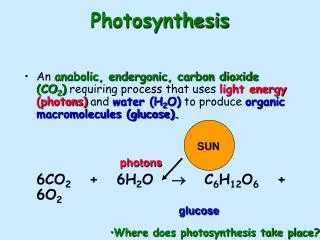
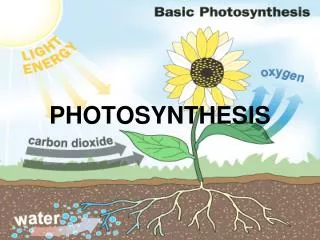
Photosynthesis is a vital process where light energy is converted into chemical energy in plants. Occurring in chloroplasts, it involves complex reactions summarized by the equation 6CO2 + 6H2O → C6H12O6 + 6O2. The process comprises light-dependent reactions and the Calvin cycle. In light reactions, photons split water, releasing O2 and generating ATP and NADPH. The Calvin cycle utilizes these products to fix CO2 into organic compounds. Various adaptations, such as C4 and CAM pathways, optimize photosynthesis under extreme conditions. Understanding these processes is crucial for enhancing plant productivity.

Understanding Photosynthesis: Mechanisms, Pathways, and Rate Influencers
E N D
Presentation Transcript
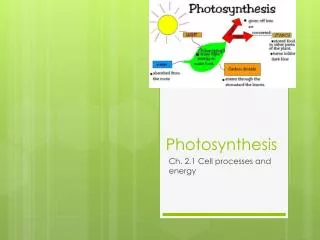
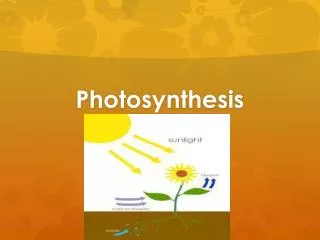
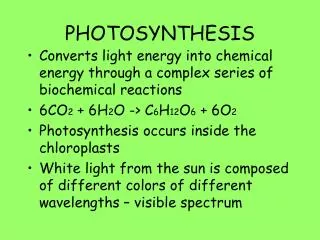
PHOTOSYNTHESIS • Converts light energy into chemical energy through a complex series of biochemical reactions • 6CO2 + 6H2O -> C6H12O6 + 6O2 • Photosynthesis occurs inside the chloroplasts • White light from the sun is composed of different colors of different wavelengths – visible spectrum
CHLOROPLAST STRUCTURE • Outer, double membrane • Inner Membrane system: • THYLAKOIDS – flattened sacs • GRANA – stacks of thylakoids • Light harvesting pigments embedded in thylakoid membrane • Surrounding thylakoids, liquid: STROMA
Photosynthesis depends upon green pigment CHLOROPHYLL (absorbs light in the blue-violet and orange-red and reflects light in green region • Accessory pigments help harvest light energy
LIGHT DEPENDENT RXNS • Visible light (traveling in “photons”, packets of energy) is changed into chemical energy • H2O is split into O2 and H • PS I and II absorb light energy • This light energy is transferred to reaction center, a Chlorophyll a that donates e- to electron carrier
LIGHT DEP. RXNS cont’d • Lost e- from PSII is replaced by e- from H2O • At end of electron flow, electrons combine with NADP+ to form NADPH • As electrons flow along electron transport chain, protons build up inside thylakoids
H3C H C1 "/, H C C H CHJ H CH3 H H H H H C CH1 J,,/HJI I I I I I I I II! I /c, /C"", /c""' /C, /C, /C""' /c, /C"", /c~ /c, /c" /CH1 H1C C C C C C C C C C C /C" I I I I I I I I I I H3C CHJ H1C, /C H H H H H CHJ H CH3 H C " H1 CH3 f,'-carotene
LIGHT DEP. RXNS cont’d • These built up protons will diffuse down concentration gradient through ATP synthase • TAH-DAH!! ATP is made!!! • PRODUCTS: • O2, ATP and NADPH!!!!
CALVIN CYCLE • Pathway that produces organic compounds, using energy stored in ATP and NADPH from the light reactions • Occurs in the stroma • CO2 is “fixed” into organic compounds • RuBP (ribulose bisphosphate) is the 5 carbon sugar that CO2 is bound to by the enzyme rubisco
More CALVIN… • The new 6 carbon molecule is immediately split into 2 3-carbon molecules (PGA) • PGA converted to PGAL by addition of the phosphate from ATP and the hydrogen from NADPH • ADP, NADP+ and phosphate are used again in the light reactions to form more ATP and NADPH
To make one molecule of G3P, three turns of the cycle + 3 CO2 molecules • CO2 is fixed to RuBP by rubisco – produces unstable intermediate -> 3-phosphoglycerate • RuBP is regenerated – one per each trip through the cycle • Uses 9 ATP and 6 NADPH
ALTERNATIVE PATHWAYS • Calvin cycle plants = C3 because of PGAL that is formed (3 carbon) • Water loss through stomates is big problem • When air is hot and dry, stomates close to prevent water loss • BAD THING – CO2 levels fall and O2 levels rise, resulting in carbon fixation inhibition
C4 PATHWAY • During hottest part of day, C4 plants partially close stomates • A special enzyme fixes CO2 into 4-carbon compounds that is stored in bundle sheath cells and can then enter the Calvin cycle • Corn, sugar cane and crabgrass
CAM Photosynthesis • Adaptation to hot, dry climates • Open stomates at night and close them during the day (minimizes water loss) • CO2 that enters at night is fixed into a variety of organic compounds and stored in vacuoles; in morning, stomates close and CO2 is then released during the day and enters Calvin cycle • These plants grow very slowly – cactuses, pineapples
Rates of Photosynthesis • 4 limiting factors: • Light intensity, temperature, [CO2], [O2] Active site of Rubisco can bind to O2 or CO2: Photorespiration – results in release of previously fixed CO2 that would otherwise remain in organic form
RATES OF PHOTOSYNTHESIS • As light intensity increases, so does rate of photosynthesis • Levels off at a max rate, when all electrons are excited • Same thing for CO2 levels • Temperature increase, rate increases to a point; then, enzymes denature and stomates close to prevent water loss, thus decreasing rate at high temperatures