
Advancements in Intermetallic-Strengthened Cobalt Alloys for High-Temperature Applications
New cobalt alloy compositions, strengthened with intermetallic L12 precipitates, demonstrate significantly enhanced performance characteristics. These Co-Al-W base alloys exhibit melting temperatures ranging from 100°C to 150°C higher than traditional Ni-base alloys, along with superior strengths above 900°C. Notably, quaternary Co-base single crystals with 2 at% Ti show an impressive 30°C creep advantage over commercial Ni-base options. Research involves density functional theory (DFT) to understand the influence of Ti on superlattice intrinsic stacking faults (SISF), promising further advancements in alloy development.

Advancements in Intermetallic-Strengthened Cobalt Alloys for High-Temperature Applications
E N D
Presentation Transcript
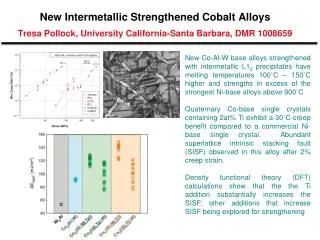
New Intermetallic Strengthened Cobalt AlloysTresaPollock, University California-Santa Barbara, DMR 1008659 New Co-Al-W base alloys strengthened with intermetallic L12 precipitates have melting temperatures 100˚C – 150˚C higher and strengths in excess of the strongest Ni-base alloys above 900˚C Quaternary Co-base single crystals containing 2at% Ti exhibit a 30˚C creep benefit compared to a commercial Ni-base single crystal. Abundant superlattice intrinsic stacking fault (SISF) observed in this alloy after 2% creep strain. Density functional theory (DFT) calculations show that the the Ti addition substantially increases the SISF; other additions that increase SISF being explored for strengthening
New Intermetallic Strengthened Cobalt AlloysTresa Pollock, University California-Santa Barbara, DMR 1008659 RISE (Research Interns in Science & Engineering) Intern, Rachel Traylor from Clemson University joined the Pollock group for a 2011 Summer Research Internship Pollock Group advised two high school CAMP (California Alliance for Minority Participation) 2011 interns Alessandro Mottura, a postdoctoral researcher on this program, has just started a position on the faculty at the University of Birmingham The research results from our program has motivated a large European program (SFB-Transregio with 14 co-PIs); Pollock is on advisory board The graduate student on this program, Mike Titus (above), was awarded a TMS Superalloys Scholarship and is one of a very few students selected to speak at the 12th International Symposium on Superalloys in September 2012