INTRODUCTION to Psychological Disorders
410 likes | 2.6k Vues
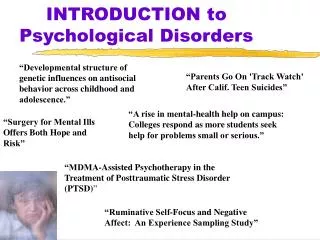
INTRODUCTION to Psychological Disorders. “Developmental structure of genetic influences on antisocial behavior across childhood and adolescence.”. “Parents Go On 'Track Watch' After Calif. Teen Suicides”.


INTRODUCTION to Psychological Disorders
E N D
Presentation Transcript
INTRODUCTION to Psychological Disorders “Developmental structure of genetic influences on antisocial behavior across childhood and adolescence.” “Parents Go On 'Track Watch' After Calif. Teen Suicides” “A rise in mental-health help on campus: Colleges respond as more students seek help for problems small or serious.” “Surgery for Mental Ills Offers Both Hope and Risk” “MDMA-Assisted Psychotherapy in the Treatment of Posttraumatic Stress Disorder (PTSD)” “Ruminative Self-Focus and Negative Affect: An Experience Sampling Study”
Defining abnormality • How would you define a “psychological disorder?” • Please get in pairs and follow the handout instructions
Defining disorder • Key elements of symptoms (according to DSM): • disturbances in behavior, thoughts, or emotions • associated with significant personal distress or impairment • stem from an internal dysfunction -- biological, psychological, or both • Criticisms?
Understanding Pathology Description Study of Psychological Disorders Causation Treatment/Outcome
Describing Disorders • DSM-IV • Diagnostic system for classifying psychological disorders • Various classes of disorders: anxiety, mood, dissociative, etc.
Potential problem of Diagnosis • Diagnoses can become labels • Consequences of labeling • Impact on others? (e.g., Rosenhan study) • Impact on self? (“I’m ADHD”) • Stigma • 70% of people with diagnosable mental disorders do not seek treatment… stigma-related?
Causes of Psychopathology • Historically • Medical model • Biopsychosocial model
Biological (heredity; brain structures; neurochemistry) Psychological (maladaptive learning & coping, cognitive biases, Interpersonal probs) Socio-cultural (socialization, stressful life circumstances, social inequities) Bio-psycho-social Perspective
Treatment / Outcome Treatments should stem from: • an attempt to understand multiple causes • research that has provided evidence of significant effectiveness for specific problems (i.e., Evidence-based Treatment, EBT)
Case study: Depression Description Study of Psychological Disorders Causation Treatment/Outcome
Describing Depression • Persistent sad, anxious, or "empty" mood • Loss of appetite and/or weight loss, or conversely overeating and weight gain • Insomnia, early-morning awakening, or oversleeping • Restlessness or irritability • Feelings of worthlessness, inappropriate guilt, helplessness, hopelessness • Difficulty thinking, concentrating, making decisions • Thoughts of death or suicide or attempts at suicide • Loss of interest or pleasure in hobbies and activities that were once enjoyed, including sex • Decreased energy, fatigue, feeling sluggish
Mood Disorders – Causal Factors • Biological • Heritability estimates (40%) (e.g., twin studies: MZ vs DZ twins -- 3 X risk) • Drugs that affect NTs (e.g., dopamine and serotonin) can relieve depression. Is this a NT-deficit, then? • Brain findings (limbic-cortical dysfunction)
1 Stressful experiences 4 Cognitive and behavioral changes 2 Negative explanatory style 3 Depressed mood Psychological factors(e.g., Cognitive-behavioral explanation) Cognitive styles (e.g., attributions, rumination
Socio-cultural factors • Poverty • Discrimination • Expectations of what it means to be happy • Level of violence in society (exposure to trauma) • Environmental factors (e.g., sunlight)