Understanding Sentence Structure: Completion and Correction Techniques
This lesson covers the fundamentals of sentence structure, including the definitions of complete sentences, phrases, and dependent clauses. It highlights the importance of modifiers in adding detail to sentences. Additionally, it explains common errors like run-on sentences and comma splices, with examples and correction practices. By focusing on effective sentence completion techniques and punctuation rules, this lesson aims to enhance your writing clarity and coherence.

Understanding Sentence Structure: Completion and Correction Techniques
E N D
Presentation Transcript
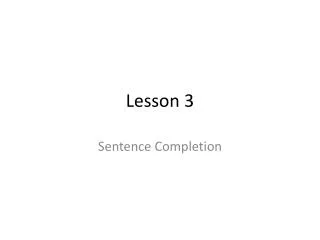
Lesson 3 Sentence Completion
Sentence structure • Sentence- a group of words that express a complete thought. • Phrase- a part of a sentecnce that does not contain its own subject and predicate. • Dependent clause is not a complete sentence- it does not not make sense on its own. • Modifiers- develop a sentence by giving further details about other words in the sentence.
Practice • After school, • Larry studies this ACT book and took tests. • After he finished studying • Larry went to baseball practice • After he studied for the test
Run-ons and Comma Splices • A run-on sentences consists of two or more independent clausees with no punctuation. They must be corrected! • Comma splice- like a run-on sentence, except that a comma separates the two clauses.
Practice • We headed off to the game during the rain the rain stopped before we got there. • Correct it?> • The computer is an invaluable tool, it links together millions of people.