Enhanced Ecosystem Management Framework for Multi-Stakeholder Platforms
90 likes | 188 Vues
This project focuses on testing an operational framework for effective stakeholder engagement, transdisciplinary approaches, and bridging the research-implementation gap in ecosystem and landscape services. It aims to contribute to the scientific understanding of values, perceptions, and trade-offs in ecosystem management. The framework includes areas like financing, policy measures, stakeholder preferences, and adaptive management strategies. Results also explore alternative payment for ecosystem services (PES) models and involve various restoration and tourism initiatives. Testing and analysis within the project contribute to decision-making processes and implementation strategies. Presentations and publications on the project's outcomes have been disseminated at various scientific forums and workshops. The next steps include MSc thesis reports, scientific publications, PhD proposals, workshops, and presentations at upcoming conferences.


Enhanced Ecosystem Management Framework for Multi-Stakeholder Platforms
E N D
Presentation Transcript
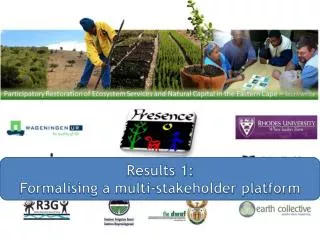
Results 1: Formalising a multi-stakeholder platform
Results 2: Testing/Applying an operational framework Remote Sensing & Geo-Information Systems Source: EarthCollective (eds) (2007b) • Testing the SELS framework with respect to: • restoration of ecosystem/landscape services (understanding the trade-offs with land-use changes) • transdisciplinarity & integration of concepts • effective stakeholder engagement (how does the framework answer the right questions for the right people?) • bridging research-implementation gap • Contribution to scientific understanding of values, perceptions, trade-offs, management & financing across institutional & geographical scales. Transdisciplinary Assessment & Implementation Framework Area Identification Multi-Functional Use Financing, Payments & Reward Mechanisms Environmental Impact Assessment Policy & Institutional Measures Ecological Valuation Stakeholder & Social Preferences Ecosystem Functioning & Biophysical Processes Synergies & Trade-offs Adaptive Management & Organisational Learning Socio-Cultural Valuation Stakeholders, Livelihoods & Networks Scoping Economic Valuation Policy & Institutional Arrangements Communication & Dissemination Scenario Development & Options (SWOT) Ecosystem Goods, Services & Valuation Stakeholder and Expert Consultation Analysis of Opportunities and Constraints Monitoring, Management Effectiveness & Evaluation Implementation Strategy Development Stakeholder and Expert Participation Decision Making Process & Implementation
Results 3: Exploring alternative interfaces for implementing PES (‘Elemental Equity’) Landschapsveiling: Bundling various ES & biodiversity outcomes ‘Restourism’ Tourism & restoration Payments for Water Services Upstream/Downstream willingness to pay/accept; Sale of water rights; ‘Working for Water’ & ‘Working for Wetlands’ ‘Earth’ Biodiversity Soil Quality & Erosion Ctrl Carbon Market Voluntary and CDM; ‘Working for Woodlands’ Landschapsveiling: Fund fire management ‘Working on Fire’
Landscape services & trade-offs Results 4: 7 MSc theses ‘Wind’ Carbon sequestration Thesis Titles: 1: Who’s willing to restore & why? Stakeholder & network analysis 2: Exploring institutional capacity for carbon sequestration schemes 3: Livelihood analysis and economic valuation of goods and services provided by the subtropical thicket ecosystem in the Baviaanskloof 4: Socio-cultural values of ecosystem services: relevance to restoration planning & implementation in the Baviaanskloof 5: Soil characteristics & optimum growth factors for Portulacariaafra. K. Janssen
How? ‘Water’ Hydrological & Watershed Services • Restoring of Wetlands and Floodplains • (how) Picture of work on piet farm (restoring flood plains), picture of the work in the Kromme (gabions) • picture’s of resembles ecosystems good & service what will improved • natural grazing livestock farming • tourism • Soil retention (dam) • Biodiversity • basis flow • water availability • picture of people working in nursery & planting (employment not ecosystem services but important) Thesis titles cont’d: 6: Valuing downstream benefits of restoring water regulation services 7: Investigating institutional arrangements required to implement PES In progress (2008/2009): Exploring upstream costs & benefits for the creation of a PES Scheme In partnership with LNV – WUR (Alterra & LEI) (Pending Partnership with Working for Wetlands)
Other Achievements • 2 Scientific Publications in progress • Zylstra, M. (in press) ‘Lessons Learned from applying the Ecosystem Approach: The Baviaanskloof’. Chapter in IUCN Commission on Ecosystem Management (CEM) Publication • Zylstra & Van den Broeck (in press) ‘Elemental Equity: An intuitive interface for mainstreaming payments for ecosystem services (PES)?’ • 7 Scientific Presentations / Papers / Posters Results presented/disseminated at: • Interfaces (Arid Zones & Fynbos) Forum: Aug. 08 • South African Thicket Forum: Aug. 08 • South African Wildlife Management Association (SAWMA): Sept. 08 • IUCN World Conservation Congress: Oct.08 • WUR-ESA Lunch Presentation: Oct. 08 • Baviaanskloof Research-Implementation Coordination Workshop: Oct.08
Planning 2009 • +/- 10 WUR MSc thesis reports • 2 Scientific Publications • 1-2 PhD position proposals • 1 PRESENCE Workshop (multi-stakeholder) • 1 Landscape Auction (Landschapsveiling) • 2 Participatory planning workshops (scientists, implementers and stakeholders) • 1 Ecosystem Management Workshop (with IUCN-CEM) • 1-2 Presentations at the Conference on Economics in Natural Resource Management (Cape Town, SA) and Water Management Conference (Port Elizabeth) • Reporting to SELS & WUR Chair Groups
Acknowledgements • - Haider Ali Javed • Lennart van der Burg • Ignacio de la Flor • Kim Janssen • Eliska Lorencova • Emmanuelle Noirtin • Janneke Spekreijse • Gamtoos Irrigation Board • R3G & its members / advisors • Eastern Cape Parks • CSIR • PRESENCE platform partners • WUR (ESA, ENP, ENR, GRS, SOQ, LEI, Alterra, • SELS) CSIR, RU, ASSET Research... • All willing & patient ‘stakeholders’...