

SlideServe
Menu
Préférences
© SlideServe · v2026

Definitions of Use

tan avatar
8 diapositives · 264 Views · Oct 07, 2014

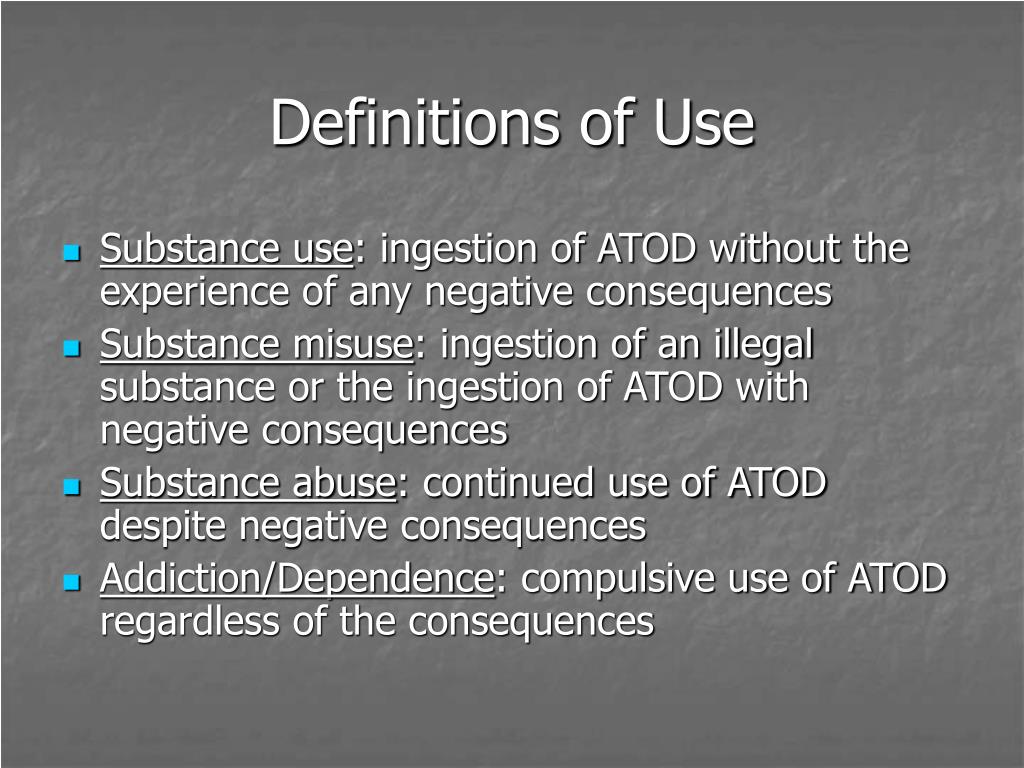
Definitions of Use. Substance use : ingestion of ATOD without the experience of any negative consequences Substance misuse : ingestion of an illegal substance or the ingestion of ATOD with negative consequences Substance abuse : continued use of ATOD despite negative consequences
Definitions of Use - slide 1
01 / 8Definitions of Use
1 / 17

Télécharger la présentation

Definitions of Use
Une image / un lien ci-dessous est fourni (tel quel) pour télécharger la présentation

Politique de téléchargement : le contenu du site vous est fourni TEL QUEL pour votre information et votre usage personnel ; il ne peut être vendu, concédé sous licence ni partagé sur d’autres sites sans l’accord de son auteur.Le contenu vous est fourni TEL QUEL, pour votre information et votre usage personnel uniquement. Téléchargez la présentation en cliquant sur ce lien. Lors du téléchargement, si vous ne parvenez pas à télécharger une présentation, l’éditeur a peut-être supprimé le fichier de son serveur.Pendant le téléchargement, si vous ne parvenez pas à obtenir une présentation, le fichier a peut-être été supprimé par l’éditeur.

F I N

Plus de contenu associé

Transcription de la présentation
  1. Definitions of Use • Substance use: ingestion of ATOD without the experience of any negative consequences • Substance misuse: ingestion of an illegal substance or the ingestion of ATOD with negative consequences • Substance abuse: continued use of ATOD despite negative consequences • Addiction/Dependence: compulsive use of ATOD regardless of the consequences

  2. Progression of Substance Use • Use of ATOD typically progresses from no use through trial and experimental use, regular use, then misuse, and for some people abuse and dependence • Gateway model: people typically experiment with alcohol and/or tobacco first, progress to alcohol intoxication, move to marijuana use, and only advance to other substances after first gaining experience with tobacco, alcohol, and marijuana

  3. Prevention Programs: Empirical Support • Promising approaches: level of certainty from available evidence is too low to support generalized conclusions, but there is some empirical basis for predicting that future research could support such conclusions • Best practices: have been show through research and evaluation to be effective in the prevention and/or delay of ATOD use/abuse • Model programs: prevention programs that have been rigorously evaluated and have repeatedly demonstrated positive outcomes

  4. Prevention Programs: General Categories • Universal prevention: relatively non-intrusive, delivered by people who are not necessarily expert in prevention, aimed at the general public or subpopulations who have not be identified at-risk • Selective prevention: more intensive tailored programs for smaller at-risk subpopulations • Indicated prevention: most intensive programs delivered by experts to individuals who have a strong pattern of risk factors or early symptoms of a clinical disorder

  5. History of Substance Use Prevention • Early 70s: knowledge-based training—universal, educative, present information about harmful consequence, non-theoretical, unsuccessful • Mid 70s: values-based training—universal, change values and teach decision making and evaluation of consequences, limited theory, limited success because of singular focus • 80s: resistance skills training—”just say no” to socials pressures, tended to be universal, more success yet effects were small, fragile and short-term

  6. History of Substance Use Prevention (cont’d) • 90s: comprehensive approaches—focused simultaneously on several major determinants of SU, tried to do more than just curb SU, used multiple delivery agents, longer duration • 90s: intensive selective interventions—rely on theory to screen for high-risk individuals, only provided to those with strong pattern of risk • 90s into 21st century: comprehensive multilevelapproaches—involve a combination of universal, selective, and indicated prevention activities, target multiple levels of influence, and address multiple problems in a single integrated program