Exploring Fuzzy Description Logics: Representing Vague Knowledge
This article delves into Description Logics (DL), which are essential for representing and reasoning about conceptual knowledge across various domains. We focus on Fuzzy Description Logic, particularly the fALCHIN framework developed by Jidi Zhao, Harold Boley, and Weichang Du. Fuzzy Sets play a crucial role in decision-making under uncertainty and effectively handle vagueness. Through examples and key concepts, we illustrate the transition from crisp to fuzzy sets, applying innovative reasoning algorithms like Extended Completion Rules and Mixed-Integer Linear Programming to enhance knowledge representation.

Exploring Fuzzy Description Logics: Representing Vague Knowledge
E N D
Presentation Transcript
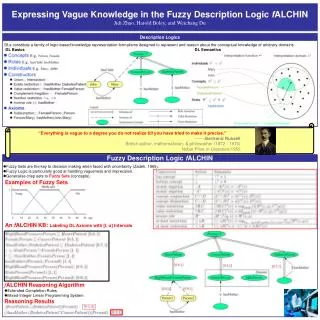
DLs constitute a family of logic-based knowledge representation formalisms designed to represent and reason about the conceptual knowledge of arbitrary domains. DL Basics DL Semantics Description Logics Expressing Vague Knowledge in the Fuzzy Description Logic fALCHINJidi Zhao, Harold Boley, and Weichang Du “Everything is vague to a degree you do not realize till you have tried to make it precise.” -------Bertrand Russell British author, mathematician, & philosopher (1872 - 1970) Nobel Prize in Literature,1950 Fuzzy Description Logic fALCHIN • Fuzzy Sets are the key to decision making when faced with uncertainty (Zadeh, 1965). • Fuzzy Logic is particularly good at handling vagueness and imprecision. • Generalise crisp sets to Fuzzy Sets (concepts). Examples of Fuzzy Sets An fALCHIN KB: Labeling DL Axioms with [l, u] Intervals fALCHINReasoning Algorithm • Extended Completion Rules • Mixed-Integer Linear Programming System Reasoning Results