Understanding Conditional Statements: Forms and Applications in Logic
This lesson explores the concept of conditional statements in logical reasoning, emphasizing their structure in "if-then" format. Students will learn how to identify and write hypotheses and conclusions correctly. Key forms such as converse, inverse, and contrapositive are introduced, highlighting their relationships and logical equivalences. Additionally, the lesson covers biconditional statements and offers practical examples, enhancing comprehension of the subject's nuances.

Understanding Conditional Statements: Forms and Applications in Logic
E N D
Presentation Transcript
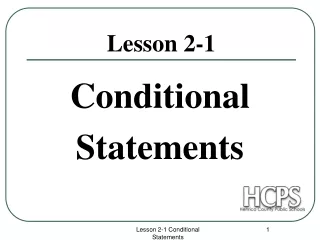
Conditional Statements Lesson 2-1 Lesson 2-1 Conditional Statements
Conditional statements can be written in “if-then” form to emphasize which part is the hypothesis and which is the conclusion. Writing Conditional Statements Hint: Turn the subject into the hypothesis. Example 1: Vertical angles are congruent. can be written as... Conditional Statement: If two angles are vertical, then they are congruent. Example 2: Seals swim. can be written as... Conditional Statement: If an animal is a seal, then it swims. Lesson 2-1 Conditional Statements
Symbolic Logic • Symbols can be used to modify or connect statements. • Symbols for Hypothesis and Conclusion: Hypothesis is represented by “p”. Conclusion is represented by “q”. if p, then q or p implies q Continued….. Lesson 2-1 Conditional Statements
Forms of Conditional Statements Converse: Switch the hypothesis and conclusion (q p) pqIftwo angles are vertical, thenthey are congruent. qpIftwo angles are congruent, thenthey are vertical. Continued….. Lesson 2-1 Conditional Statements
Forms of Conditional Statements Inverse:State the opposite of both the hypothesis and conclusion. (~p~q) pq :Iftwo angles are vertical, thenthey are congruent. ~p~q:Iftwo angles are not vertical, thenthey are not congruent. Lesson 2-1 Conditional Statements
Forms of Conditional Statements Contrapositive: Switch the hypothesis and conclusion and state their opposites. (~q~p) pq : Iftwo angles are vertical, thenthey are congruent. ~q~p:Iftwo angles are not congruent, thenthey are not vertical. Lesson 2-1 Conditional Statements
Forms of Conditional Statements • Contrapositives are logically equivalent to the original conditional statement. • If pq is true, then qp is true. • If pq is false, then qp is false. Lesson 2-1 Conditional Statements
Biconditional • When a conditional statement and its converse are both true, the two statements may be combined. • Use the phrase if and only if (sometimes abbreviated: iff) Statement: If an angle is right then it has a measure of 90. Converse:If an angle measures 90, then it is a right angle. Biconditional:An angle is right if and only if it measures 90. Lesson 2-1 Conditional Statements