Download
1 / 2
20 likes | 201 Vues
Acid precipitation is a global environmental concern caused by the emission of sulfur, nitrogen, and carbon oxides from industries. These gases combine with water vapor to create various acids, including sulfuric and nitric acids, leading to rainfall with a pH lower than normal. The consequences include reduced soil fertility, delayed tree growth, harm to aquatic ecosystems, and corrosion of metal surfaces. Acidic conditions, particularly during spring thaws, can lead to "acid shock," severely impacting water quality and biodiversity.

E N D
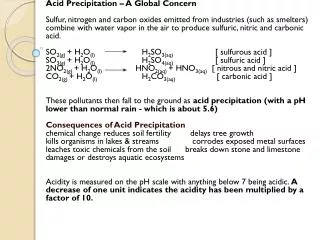
Acid Precipitation – A Global Concern • Sulfur, nitrogen and carbon oxides emitted from industries (such as smelters) combine with water vapor in the air to produce sulfuric, nitric and carbonic acid. • SO2(g) + H2O(l) H2SO3(aq) [ sulfurous acid ] • SO3(g) + H2O(l) H2SO4(aq) [ sulfuric acid ] • 2NO2(g) + H2O(l) HNO2(aq) + HNO3(aq) [ nitrous and nitric acid ] • CO2(g) + H2O(l) H2CO3(aq) [ carbonic acid ] • These pollutants then fall to the ground as acid precipitation (with a pH lower than normal rain - which is about 5.6) • Consequences of Acid Precipitation • chemical change reduces soil fertility delays tree growth • kills organisms in lakes & streams corrodes exposed metal surfaces • leaches toxic chemicals from the soil breaks down stone and limestone damages or destroys aquatic ecosystems • Acidity is measured on the pH scale with anything below 7 being acidic. A decrease of one unit indicates the acidity has been multiplied by a factor of 10.
Acidity is measured on the pH scale with anything below 7 being acidic. A decrease of one unit indicates the acidity has been multiplied by a factor of 10. • Periods of extreme acidity (like in the spring when the acid snow melts and the acidic water enters the waterways) are called acid shock.