The Importance of Offshore Energy Generators for Sustainable Power
Offshore energy generators are crucial for harnessing clean and sustainable energy from marine environments. With sea water being 832 times denser than air, even slow currents can produce significant kinetic energy. These generators do not occupy valuable land, allowing for its use in other capacities. Tidal power is renewable, free of harmful byproducts, and poses less environmental risk. Compared to wave energy systems, tidal stream energy is more straightforward and cost-effective, with current technologies like wind turbines providing enhanced durability and efficiency.

The Importance of Offshore Energy Generators for Sustainable Power
E N D
Presentation Transcript
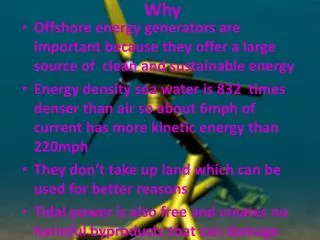
Why • Offshore energy generators are important because they offer a large source of clean and sustainable energy • Energy density sea water is 832 times denser than air so about 6mph of current has more kinetic energy than 220mph • They don’t take up land which can be used for better reasons • Tidal power is also free and creates no harmful byproducts that can damage the environment.
Advantages • Tidal stream energy compared to wave and ocean thermal energy is that it is a simple and based off the simple wind turbine • Current turbines are a lot more durable , cheaper to build than wave energy systems, and advances are made faster in this field
Reference • Ocean Wave Energy Conversion Dr. AnetteMuetzehttp://homepages.cae.wisc.edu/~vining/JVining_WaveEnergyConversion.pdf • Ocean Current’s Energy How to Produce Electricity Thanks to the Marine Currents by Natalia Moreno, Roger Sallent, Alejandro Espi, DixiaoBao, YohannTeillethttp://www.exergy.se/goran/hig/re/08/ocean.pdf • Ocean Energy by Marten Grabbe Urban Luadin and Mats Leijonhttp://www.eusustel.be/public/documents_publ/WP/WP3/WP3%20report%20-%20Marine%20Currents%20and%20Wave.pdf
References • http://www.crses.sun.ac.za/technologies-ocean.php • Technology White Paper on Ocean Current Energy Potential on the U.S. Outer Continental Shelf, by Mineral Management Service, Renewable Energy and Alternate Use Program, U.S. Department of the Interior http://ocsenergy.anl.gov/documents/docs/OCS_EIS_WhitePaper_Current.pdf
Reference • http://www.marineturbines.com/6/background/14/seaflow/ • http://www.marineturbines.com/3/news/article/56/seagen_tidal_turbine_gets_all_clear_from_environmental___scientific_studies/ • Marine Current Turbines: Progress with Tidal Turbine Development by Peter Fraenkelhttp://library.coastweb.info/728/1/Microsoft_Word_-_Fraenkel_Marine_Current_TurbinesPAPER.pdf
Reference • http://tommytoy.typepad.com/tommy-toy-pbt-consultin/2011/11/marine-energy-has-long-looked-to-be-a-niche-area-capable-of-meeting-just-a-few-percent-of-global-power-demand-but-this-se.html • http://www.ehow.com/how-does_4574050_tidal-energy-work.html