Download
1 / 3
30 likes | 144 Vues
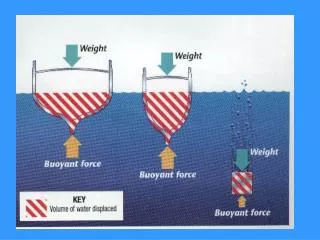
This text explores the principles of buoyancy, demonstrating why three objects of equal weight behave differently in water. A cube sinks because it displaces less water, failing to generate enough buoyant force to counteract its weight. In contrast, ships float by displacing a significant volume of water, creating sufficient buoyant force to support their weight. The legend of the candy cane illustrates water displacement effectively, while the comparison of buoyancy forces (BF) and weight (WT) clarifies the conditions under which objects float or sink.

E N D
All three objects weigh the same. The weight arrow is the same for all three. The candycane legend shows the amount of water each object displaces. The cube sinks. It sinks because it does not displace very much water. The weight of the displaced water is not enough to overcome the force of gravity (the weight). BF<WT The ships float. They are able to displace a lot of water. Notice that the second ships sits slightly lower in the water and more of the ship is under water in order to displace enough water to float. BF>WT So, the ships sink until they float.
The BF on both ships is > OR EQUAL TO the WT of the ships. This is why the ships float. BF > WT The BF on the cube is < than the WT of the cube. This is why the cube sinks. BF< WT