Download
1 / 6
80 likes | 313 Vues
Master the use of negative expressions in Spanish, including nunca, nada, nadie, and ninguno/a. This guide explains how to place these expressions before or after the verb for correct sentence structure. Learn to use "nada" and "nadie" as subjects and the importance of the personal "a" when they act as objects. Understand the singular forms of "ninguno" and "ninguna," how they match gender, and when to place them in a sentence. Improve your Spanish fluency by properly incorporating these negative expressions into your conversations.

E N D
Vocabulary • Nunca= Never • Nada= Nothing • Nadie= Nobody • Ninguno(a)= None/Not a one • Tampoco= Neither
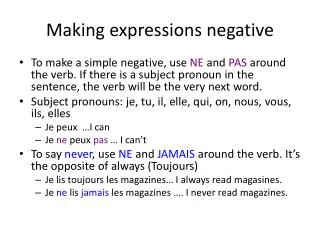
How to use negative expressions: • Negative expressions in Spanish go before the verb. • Nuncaveotelevisióndurante la semana • Or afterthe verb place nobefore the verb. • Noveotelevisiónnuncadurante la semana.
Nada y Nadie • When nada (nothing) and nadie (nobody) are subjects, they are placed before the verb. • Nadiejuegamejorqueyo • When they are the object they can follow the verb or the preposition • No quierohacernada • Use the personal a with nadiewhen it’s the object of a verb. • No conozcoa nadieaquí. subject precedes verb object follows verb
Using ninguno/ninguna • Use ningunoand ningunato say none, not (a single) one. • Ojo~ninguno becomes ningún before a masculine noun. Notengoningúnpósterde España • They are generally used in the singular and match the noun they describe in gender. • Estos son los teléfonos. Ningunofunciona. • Ninguna persona hizo la tarea.
Ninguno/Ninguna cont. Ningunoand ningunacan stand alone, or they can go before a noun. • If ninguno(a) follows the verb in the sentence, place nobefore the verb. • ¿Cuántasestampillasde Costa Rica tienes? • Notengoninguna.