Download
1 / 12
120 likes | 225 Vues
This study explores the dynamics of conversation involving individuals with acquired progressive dysarthria, specifically focusing on how speech intelligibility is managed in everyday social interactions. Through conversation analysis of naturally occurring interactions among couples affected by MND/ALS, the research identifies various trouble sources in conversation, including simple and complex issues. It highlights participants' repair strategies, collaborative actions, and the implications of unintelligibility for social interaction, aiming to provide insights for clinicians and caregivers.

E N D
Dysarthric talk in everyday social conversation: the nature and repair of simple and complex trouble sources.Steven Bloch & Ray WilkinsonDept of Human Communication ScienceUniversity College London
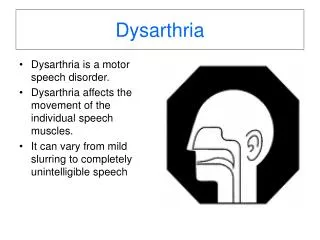
Acquired progressive dysarthria in conversation • How is talk in conversation managed when one person has reduced speech intelligibility? • Interest in the everyday social consequences of dysarthria - how it is ‘played out’ (accomplished) by people at home? • How are problems with intelligibility, when they occur, identified and repaired by participants during conversation?
Methodology : Conversation Analysis • Three couples with MND/ALS - all experiencing mild/moderate dysarthria at recruitment stage • Videos of naturally occurring interaction • Data collected at three monthly intervals over a maximum 18-month period • Data transcribed, repeatedly viewed and analysed for different patterns of interaction through talk
Repair in conversation (Schegloff, Jefferson and Sacks 1977) • Self or other initiation of repair - someone displays a problem or trouble within current turn or in a following turn • An identified trouble source - the problem itself • Self or other completion of the repair - an attempt to resolve the trouble • Other-initiated self-repair identified as a common pattern within the data for this study
Simple (single) trouble source - Rose and Tom R: no down near Pahrnam T: near where? R: near Pahrnam T: oh so it’s not so far then R: no
Simple (single) trouble source - Mary and Stan M: a big (.) help. (2.0) S: mm? M: a big (0.5) help S: you get oh it’s a big help yeah it is
Complex (single) trouble source - Mary and Stan M: spine (2.0) S: mind the what? M: spine (1.0) S: spine? Complexity with reference to turn action and not just intelligibility
Multiple trouble source - Rose and Tom • More than one trouble source • Multiple attempts to resolve • the trouble • Resolved through serial • repair of separate elements • within the turn
Multiple trouble source - Mary and Stan M: there was a another one last week but she couldn’t settle S: she did what last week? M: (repair via speech and AAC) S: this is this woman Gladys?
Repair in dysarthria • The real social consequence of unintelligibility • Simple and multiple trouble sources • Beyond (un)intelligibility - understandability • Natural speech and AAC are NOT mutually exclusive resources • Collaborative action between participants
Implications • Understanding dysarthria beyond intelligibility measures - seeing how people ‘do dysarthria’ • Possible ideas for assessment/outcomes - participants own strategies and resources • Possible ideas for intervention - what works for each dyad? What causes problems? • Clinician doesn’t assume expertise in dyads own resources • Single and multiple NOT simple and complex!
For further information please feel free to contact: s.bloch@ucl.ac.uk