
EFFECTS WORKING GROUP
E N D
Presentation Transcript
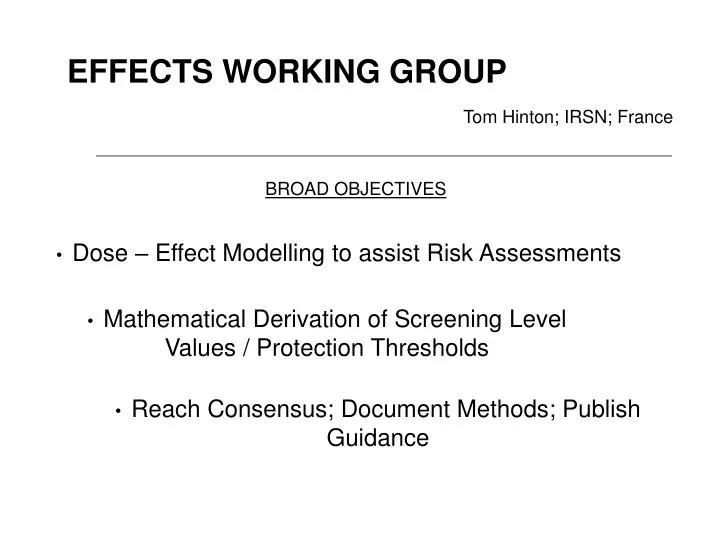
EFFECTS WORKING GROUP Tom Hinton; IRSN; France BROAD OBJECTIVES • Dose – Effect Modelling to assist Risk Assessments • Mathematical Derivation of Screening Level Values / Protection Thresholds • Reach Consensus; Document Methods; Publish Guidance
EFFECTS GROUP Active Participants
EFFECTS GROUP Outline of Working Plan • UPDATE Dose-Effect DATABASE (11; A. Real; Spain; July ‘09) • ( UNSCEAR; post 2006; Russian/Ukrainian) • DOSE – RESPONSE Relationships (13; J. G-L; IRSN; July ’11; PROTECT) • Species Sensitivity Distributions (acute vs chronic; field- vs lab-derived; • at various taxonomic levels) • 3) Incorporate POPULATION MODELS (9; T. Sazykina; Russia; Jan. ‘11) • (Review existing models; life history data; data analyses) • 4) Alternative Approaches (9; T. Sazykina; Russia; Jan. ’11; ICRP comm. 5) • (will non-parametric and Bayesian methods produce screening levels similar to SSD?)
EFFECTS GROUP Outline of Working Plan • 5) Multiples Stressors (13; H. Vandenhove; Belgium; Dec. ’10; IUR) • (Review literature; chemical industry; report on applicability to IAEA; collaborative exp.) 6) Canadian Benthic Data (4; S. Mihok; Canada; July ‘09) (Uranium mining; derive dose to benthos; multivariate stats) • 7) Develop and Publish Guidance Documents (21; T. Hinton; France; July. ‘11) • (Documentation of methods to derive screening levels; guidance on use of screening levels; guidance in conducting effects type research) 8) Final Reports to IAEA (21; T. Hinton; France; Jan. ‘12)
EFFECTS GROUP Next Meeting June or July of 2009; Monaco or Vienna; with BIOTA Working Group