Analysis of Fast Vertical Single-Bunch Instability at SPS Injection: Insights from BBU and TMC Theories
160 likes | 278 Vues
This study presents a comprehensive follow-up on the fast vertical single-bunch instability observed during SPS injection, incorporating animations illustrating the BBU theory's propagation direction and a review of Laclare’s theory on azimuthal and radial modes. We analyze the coupling between various instability modes and present SPS measurement results with chromaticities of 0.14, 0.54, and 2.04. Detailed comparisons of theoretical predictions and experimental data are made, aiming to elucidate the observed phenomena and responses to varying conditions through BBU theory.


Analysis of Fast Vertical Single-Bunch Instability at SPS Injection: Insights from BBU and TMC Theories
E N D
Presentation Transcript
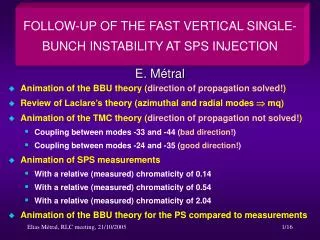
FOLLOW-UP OF THE FAST VERTICAL SINGLE- BUNCH INSTABILITY AT SPS INJECTION E. Métral • Animation of the BBU theory (direction of propagation solved!) • Review of Laclare’s theory (azimuthal and radial modes mq) • Animation of the TMC theory (direction of propagation not solved!) • Coupling between modes -33 and -44 (bad direction!) • Coupling between modes -24 and -35 (good direction!) • Animation of SPS measurements • With a relative (measured) chromaticity of 0.14 • With a relative (measured) chromaticity of 0.54 • With a relative (measured) chromaticity of 2.04 • Animation of the BBU theory for the PS compared to measurements
BBU THEORY BB resonator impedance 1st trace = turn 1 Last trace = turn 115 Every turn shown
LACLARE’S FORMALISM (1/6) • Follow-up of last RLC meeting when I said that the spectrum of mode mq (σmq) is peaked at and extend 2 modes with same q are peaked at the same frequency (same line density), and therefore have ~ the same sensitivity in the same frequency range. They however correspond to entirely different patterns in phase space…
(2/6) LACLARE’S RESULTS – CERN 87-03, p. 315 (1/2) and not specified with
(3/6) LACLARE’S RESULTS – CERN 87-03, p. 316 (2/2)
(4/6) MY RESULTS (1/2)
(5/6) MY RESULTS (2/2)
LACLARE’S FORMALISM (6/6) • I have the same results as Laclare (I use his formalism…) except for σ02 , σ11 , σ33 , where I have an opposite sign • I also have an opposite sign for X02 , X11 , X33 • However, it has no effect on the signal observed at a Pick-Up • And it has also no effect in the computation of the tune shift as it is σmq2 which enters into the formula
TMC THEORY: coupling between modes -33 and -44 1st trace = turn 1 Last trace = turn 115 Every turn shown
TMC THEORY: coupling between modes -24 and -35 (1/2) 1st trace = turn 1 Last trace = turn 115 Every turn shown
TMC THEORY: coupling between modes -24 and -35 (2/2) • I asked to Elena Shaposhnikova if one can identify which (radial) modes couple: -2? with -3? (In her paper CERN/SL/93-43 (RFS) on MOSES’s results, it is said that if coupling of mode m is important, radial modes up to k ~ |m| / 2 have to be considered) • If k = 1 then it is the same case as the one of the previous page
MEASUREMENTS WITH A CHROMATICITY OF 0.14 1st trace (in red) = turn 2 Last trace = turn 150 Every turn shown
MEASUREMENTS WITH A CHROMATICITY OF 0.54 1st trace (in red) = turn 2 Last trace = turn 150 Every turn shown
MEASUREMENTS WITH A CHROMATICITY OF 2.04 1st trace (in red) = turn 2 Last trace = turn 150 Every turn shown
BBU THEORY FOR THE PS AT TRANSITION (1/2) BB resonator impedance 1st trace = turn 1 Last trace = turn 90 Every turn shown
BBU THEORY FOR THE PS AT TRANSITION (2/2) MEASUREMENTS IN 2000 BBU THEORY AFTER 90 TURNS (~ 200 μs) Seem very close except head and tail exchanged!!! Does it start only for the maximum peak intensity, i.e. in the middle???