Download
1 / 1
10 likes | 164 Vues
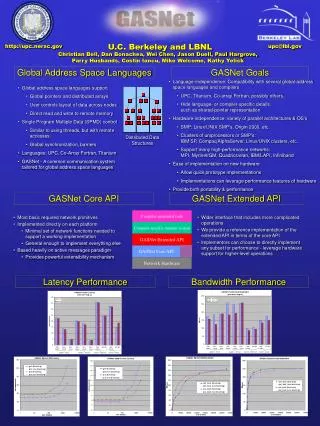
GASNet provides a language-independent communication framework designed for global address space languages such as UPC, Co-Array Fortran, and Titanium. It emphasizes compatibility with various compilers and architectures, ensuring the ease of implementation across different hardware platforms, including SMPs and clusters. GASNet supports a wide range of high-performance networks, offering direct remote memory access and global synchronization mechanisms. Its extensible API facilitates prototyping while leveraging hardware performance features, catering to diverse computational needs in parallel environments.

E N D
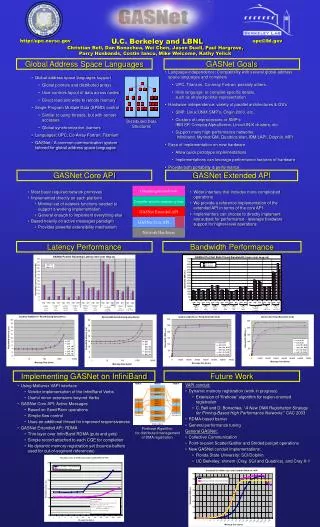
Compiler-generated code Compiler-specific runtime system GASNet Extended API GASNet Core API Network Hardware Distributed Data Structures U.C. Berkeley and LBNL http://upc.nersc.gov upc@lbl.gov Christian Bell, Dan Bonachea, Wei Chen, Jason Duell, Paul Hargrove, Parry Husbands, Costin Iancu, Mike Welcome, Kathy Yelick Global Address Space Languages GASNet Goals • Language-independence: Compatibility with several global-address space languages and compilers • UPC, Titanium, Co-array Fortran, possibly others.. • Hide language- or compiler-specific details, such as shared-pointer representation • Hardware-independence: variety of parallel architectures & OS's • SMP: Linux/UNIX SMP's, Origin 2000, etc. • Clusters of uniprocessors or SMP's: IBM SP, Compaq AlphaServer, Linux/UNIX clusters, etc. • Support many high-performance networks:MPI, Myrinet/GM, Quadrics/elan, IBM/LAPI, Infiniband • Ease of implementation on new hardware • Allow quick prototype implementations • Implementations can leverage performance features of hardware • Provide both portability & performance • Global address space languages support • Global pointers and distributed arrays • User controls layout of data across nodes • Direct read and write to remote memory • Single Program Multiple Data (SPMD) control • Similar to using threads, but with remote accesses • Global synchronization, barriers • Languages: UPC, Co-Array Fortran, Titanium • GASNet - A common communication system tailored for global address space languages GASNet Core API GASNet Extended API • Most basic required network primitives • Implemented directly on each platform • Minimal set of network functions needed to support a working implementation • General enough to implement everything else • Based heavily on active messages paradigm • Provides powerful extensibility mechanism • Wider interface that includes more complicated operations • We provide a reference implementation of the extended API in terms of the core API • Implementors can choose to directly implement any subset for performance - leverage hardware support for higher-level operations Latency Performance Bandwidth Performance