Understanding Work and Energy in Physics: Concepts, Theorems, and Applications
320 likes | 433 Vues
This guide explores the fundamentals of work and energy, focusing on the physicist's definition of work as a scalar quantity. We delve into the work-energy theorem, the relationship between work and kinetic energy, and gravitational potential energy. Key concepts include the calculations of work done by gravity, the role of conservative and dissipative forces, and energy conservation principles. Relevant examples, such as free fall and spring dynamics, illustrate these concepts in action. Lastly, we touch on power, energy units, and their real-world applications.


Understanding Work and Energy in Physics: Concepts, Theorems, and Applications
E N D
Presentation Transcript
Physicist’s definition of “work” dist∥ A scalar (not a vector) dist Work = F x dist∥
Atlas holds up the Earth But he doesn’t move, dist∥ = 0 Work= Fx dist∥ = 0 He doesn’t do any work!
Garcon does work whenhe picks up the tray but not while he carries it around the room dist is not zero, but dist∥ is 0
Why this definition? A vector equation Newton’s 2nd law: F=ma Definition of work + a little calculus A scalar equation Work= change in ½mv2 This scalar quantity is given a special name: kinetic energy
Work = change in KE This is called: the Work-Energy Theorem
Units again… Kinetic Energy = ½mv2 m2 s2 kg work = F x dist∥ same! =1Joule m s2 N m =kg m
Work done by gravity end start dist dist∥ change in vertical height W=mg Work = F x dist∥ = -mg xchange in height = -change in mgh
Gravitational Potential Energy Workgrav = -change in mgh This is called: “Gravitational Potential Energy” (or PEgrav) change in PEgrav = -Workgrav Workgrav = -change in PEgrav
If gravity is the only force doing work…. Work-energy theorem: -change in mgh = change in ½ mv2 0 = change in mgh + change in ½ mv2 change in (mgh + ½ mv2) = 0 mgh + ½ mv2 = constant
Conservation of energy mgh + ½ mv2 = constant Gravitational Potential energy Kinetic energy If gravity is the only force that does work: PE + KE = constant Energy is conserved
Free fall(reminder) height t = 0s 80m V0 = 0 75m t = 1s V1 = 10m/s 60m t = 2s V2 = 20m/s t = 3s 35m V3 = 30m/s t = 4s 0m V4 = 40m/s
m=1kg free falls from 80m mgh ½ mv2 sum t = 0s V0 = 0 h0=80m 800J 0 800J t = 1s 750J 50J V1 = 10m/s; h1=75m 800J t = 2s V2 = 20m/s; h2=60m 600J 200J 800J t = 3s V3 = 30m/s; h3=35m 350J 450J 800J t = 4s V4 = 40m/s; h4=0 0 800J 800J
pendulum T W=mg Two forces: T andW T is always ┴ to the motion (& does no work)
Pendulum conserves energy E=mghmax E=mghmax hmax E=1/2 m(vmax)2
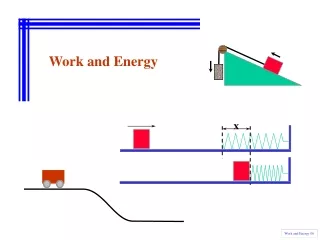
Work done by a spring Relaxed Position F=0 x F I compress the spring (I do + work; spring does -work) Work done by spring = - change in ½kx2
Spring Potential Energy Workspring = -change in ½kx2 This is the: “Spring’s Potential Energy” (or PEspring) Workspring = -change in PEspring change in PEspring = -Workspring
If spring is the only force doing work…. Work-energy theorem: -change in ½ kx2 = change in ½ mv2 0 = change in ½ kx2 + change in ½ mv2 change in ( ½kx2 + ½mv2) = 0 ½ kx2 + ½ mv2 = constant
Conservation of energysprings & gravity mgh + ½kx2 + ½mv2 = constant Gravitational potential energy spring potential energy Kinetic energy If elastic force & gravity are the only force doing work: PEgrav + PEspring + KE = constant Energy is conserved
Two types of forces: • “Conservative” forces • forces that do + & – work • Gravity • Elastic (springs, etc) • Electrical forces • … • “Dissipative” forces • forces that only do – work • Friction • Viscosity • …. -work heat (no potential energy.) -work change in PE
Thermal atomic motion Air solid Heat energy= KE and PE associated with the random thermal motion of atoms
Work-energy theorem(all forces) Workfric = change in (PE+KE) Work done dissipative Forces (always -) potential energy From all Conservative forces Kinetic energy -Workfric= change in heat energy Workfric= -change in heat energy -change inHeat Energy = change in (PE+KE)
Work – Energy Theorem(all forces) 0 =change inHeat Energy + change in (PE+KE) 0 =change in (Heat Energy+PE+KE) Heat Energy + PE + KE = constant Law of Conservation of Energy
Energy conversion while skiing Potential energy Potential energykinetic energy Friction: energy gets converted to heat
Units again Heat units: 1 calorie = heat energy required to raise the temp of 1 gram of H2O by 1o C Kg m2/s2 1 calorie= 4.18 Joules
Food Calories 1 Calorie = 1000 calories = 1Kcalorie The Calories you read on food labels 1 Calorie= 4.18x10³ Joules 7 x 10⁶ J 8 x 10⁵ J 2 x 10⁶ J
Power amount of energy elapsed time Rate of using energy: Power = Joule second Units: 1 = 1 Watt A 100 W light bulb consumes 100 J of electrical energy each second to produce light
Other units Over a full day, a work-horse can have an average work output of more than 750 Joules each second 1 Horsepower = 750 Watts
Kilowatt hours energy time Power = energy = power x time power unit x time unit = energy unit Kilowatts (103 W) hours (3600s) Elec companies use: x 1 kilowatt-hour = 1kW-hr = 103W x 3.6x103s = 3.6x10⁶ Ws J