The Market Research Process
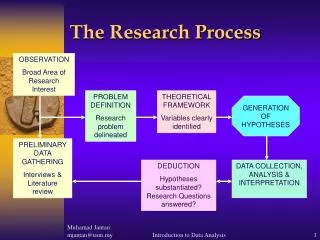
This chapter provides a comprehensive overview of the market research process, detailing the five essential steps: defining the problem, obtaining data, analyzing that data, recommending solutions, and applying the results. It emphasizes the importance of clearly identifying the problem and gathering both primary and secondary data. The various methods of data collection—such as surveys, observations, and experiments—are also explored, highlighting their advantages and disadvantages. This guide aims to equip businesses with the knowledge necessary to conduct effective market research.


The Market Research Process
E N D
Presentation Transcript
The Market Research Process Chapter 29.1
5 Steps of the Market Research Process • Define the Problem • _____________________ • Analyzing Data • Recommending Solutions • ______________________
Step 1: Defining the Problem • Most difficult step of the research process • _______________occurs when a business clearly identifies a problem and what is needed to solve it. • Helps researcher create objectives that will help answer the problem • Objectives are used to develop the ___________________
Step 2: Obtaining Data • Data (or ______) are collected • Primary Data - obtained for the _______time and used specifically for the particular problem under study • Secondary Data - ___________; previously collected for some other purpose
Ways to collect Secondary Data • ________________– company home pages, digital dossiers, business clearinghouses • U.S. and State Government Sources – data collected by the government, like population demographics and economic trends • ____________________– companies collect data to sell to other businesses like demographic data, economic forecasts, and consumer purchase information • Business Publications – BusinessWeek, Forbes, Wall Street Journal
Ways to collect Secondary Data • U.S. and State Government Sources – _______ collected by the government, like population demographics and economic trends • Specialized Research – companies collect data to _______to other businesses like _____________ data, economic forecasts, and consumer purchase information
Secondary Data Advantages Disadvantages • Easily obtained • __________________ • Saves time and money • Data may not be suitable for the problem under study • __________________
Ways to collect Primary Data • _____________________ • The Technological Method • _______________ • The Observation Method • The Experimental Method
The Survey Method • Information is gathered from people through the use of surveys or questionnaires • _______________________________ • Conducted in person, by phone, by mail or Internet • __________– survey the entire target population • Not usual because population is normally too large and it would cost too much money and time • Sample– part of the target population that represents it accurately • Size of sample depends on the amount of time and money available • Generally speaking, the larger the sample the more accurate the results
Technological Method • Online surveys and focus groups – survey is conducted in a “chat room” environment • Smart Phones/Devices – IPods, ____________ • Fax broadcasts – questionnaires can be sent to a select group of fax numbers • _______________________ • automatically rejects busy signals and answering machines • Prerecorded voice walks caller through a series of questions and caller responds with key pad
Interviews • Questioning people _____________ • Because it is expensive they are usually conducted in central locations • “Mall Intercept Interviews” - (started in shopping malls) • Focus Group Interview – 8-12 people brought together to evaluate ___________, product, or __________ under the direction of a moderator
The Observation Method • Peoples actions are ___________ ___________________ • Better results because people are __________that they are being observed • Mystery Shoppers – sent in to observe interactions between customers and employees • Disadvantage – cannot measure ___________or __________
The Observation Method • Point-of-Sale Research – combines natural observation with personal interview • People can explain their ___________________
The Experimental Method • Researcher observes results when changing one or more marketing variables while keeping all the others constant • Used to test: • __________________________ • Media usage • ___________________
Step 3: Analyzing the Data • The process of compiling, analyzing and interpreting results • _____________ – computer process that uses statistical methods to extract new information from large amounts of data
Step 4: Recommending Solutions to the Problem • Conclusions drawn form research are usually presented in an ____________________
Step 5: Applying the Results • After research is completed and changes have been made, businesses must monitor the results carefully. • The research efforts were a success if resulting decisions lead to increased sales.
Review • What are the five steps to market research? • Defining the problem, obtaining data, analyzing data, recommending solutions, applying results • What are the two types of research? • Primary and Secondary • What are the five methods used to collect primary data? • Survey methods, technological method, interview, observation method, experimental method