Bridging the Digital Divide: Understanding Perspectives Across Generations
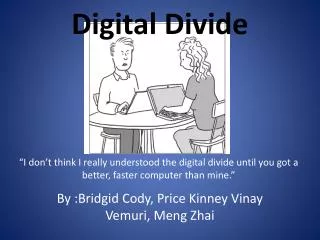
The digital divide highlights the disparity between those with and without access to digital technology. Young digital natives engage comfortably with the internet, multitasking and utilizing social networks, while digital immigrants often prefer traditional methods. Adults frequently view youth’s internet habits as unproductive, while youth see technology as essential for information and connection. To overcome misconceptions, fostering a trans-generational understanding is crucial. This collective approach can bridge the divide and enhance digital participation among all age groups.

Bridging the Digital Divide: Understanding Perspectives Across Generations
E N D
Presentation Transcript
C@CM Project Digital Divide Group Members: 1. Lee KiatCheah 2. Jyo Lyn Hor 3. Brian Groudan 4. Emily Grove 5. Bup Kim
Introduction • Wikipedia defines the term ‘digital divide’ as the gap between people with effective access to digital and information technology and those with very limited or no access at all. It includes the imbalances in physical access to technology as well as the imbalances in resources and skills needed to effectively participate as a digital citizen.
Difference in Digital Practices between Generations • Digital natives (younger generation who grew up with technology) are more comfortable with using the internet. They multitask and engage in online social networking. • Digital immigrants (adults who adapt to technology) do not rely heavily on the internet to perform tasks - printing out a digital document to edit it rather than editing it online, for example. (Prensky, 2001a, p. 4).
The Roots of Digital Divide(Adults’ Perspectives) • Adults discriminate youth as being ‘totally different’ from their own generation in several aspects like their internet usage and learning methods. For example, the adults do not believe that multitasking(studying while Facebook-ing and watching videos on Youtube) is an effective way to learn. • The adults think that social networking online is a waste of time and friendships on social networking sites are superficial.
The Roots of Digital Divide(Youth’s Perspectives) • Teenagers think that technological resources are vital for them to look up for information and stay in touch with their peers. Internet gives them the chance to access and explore the world beyond boundaries. • Teenagers find it unreasonable for adults to control and intrude their online spaces to monitor their online activities.
Conclusion • Some experts find out that technology is not the blame behind the perceived “digital divide”. Therefore, a trans-generational understanding should be fostered in order to dissipate this misconception.