Download
1 / 21
210 likes | 319 Vues
This segment focuses on traffic management in networking systems, particularly highlighting flow control and error control mechanisms. It illustrates how TCP acknowledges data transmission, regulates the transfer rate based on network conditions, and manages congestion. The chapter elaborates on different techniques including stop-and-wait, sliding windows, and Go-Back-N ARQ, explaining the importance of these methods in ensuring efficient data delivery and retransmission in the presence of errors. The performance analysis of these mechanisms, including throughput calculations under various network conditions, is also discussed.

E N D
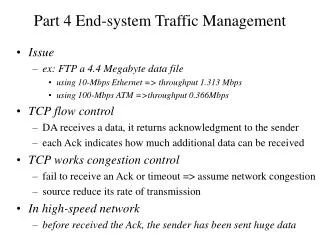
Part 4 End-system Traffic Management • Issue • ex: FTP a 4.4 Megabyte data file • using 10-Mbps Ethernet => throughput 1.313 Mbps • using 100-Mbps ATM =>throughput 0.366Mbps • TCP flow control • DA receives a data, it returns acknowledgment to the sender • each Ack indicates how much additional data can be received • TCP works congestion control • fail to receive an Ack or timeout => assume network congestion • source reduce its rate of transmission • In high-speed network • before received the Ack, the sender has been sent huge data
Chapter 11 Link-Level Flow and Error Control • Flow Control • limit the amount or rate of data that is sent • Why needs flow control • destination protocol processing may slower than transmitter • limited buffer capacity may fill up • Link-level flow control (physical link) • Network-level flow control (logical connection) • Error Control :to recover from the loss or damage of PDU • involve error detection (based on a frame check sequence ) • PDU retransmission
Link Control Mechanisms • Why we need to segment message into a sequence of frames • receiver buffer size is limited • if incurs error, retransmission overhead is small • fairness on the shared medium • Link-level flow and error control • stop and wait • sliding windows • Go-Back-N • selective reject
Stop and Wait • Sender sends a frame and wait until it receives the Ack sent by the receiver • two types of errors • Tx data error (CRC detection) => no Ack • source station actives a timer when it sends a frame • Ack error => source time out and retransmission • receiver receives duplicate frame • 1-bit sequence number • automatic repeat request (ARQ) • use error detection, timers , acknowledgments, and retransmission
Stop-and-Wait utilization • Fig. 11.4 illustrates the link utilization • assuming no errors, the maximum sending frame rate is 1/Tframe, • the maximum stop-and-wait maximum frame rate is 1/(Tframe + 2Tprop+Tack) • Tprop: the duration between the first bit of frame leaves from source and the first bit of the frame arrives at destination • Tframe: the transmission time for the data frame • Tack: the transmission time for the Ack frame
Sliding-window Techniques • Window size n: destination station buffer capacity • sender is allowed to send n frames without waiting for any Ack • Sequence number: to keep track of which frames have been Ack. • Ack. Frame includes the sequence number of the next frame expected • if ack’s sequence number is 5, it means that frame 1,2,3,4 have been received • Fig. 11.5 and Fig. 11.6 depict the sliding-window process • RR3 means receive ready 3 (equal to Ack3)
Go-back-N ARQ • Most commonly used of the sliding-window • if destination detects a error frame, it sends a REJ frame (reject ack frame) and discard all future incoming frames until the frame in error is correctly received • sender must retransmit the frame in error plus all succeeding frames • three cases for damaged frame :(A: sender, B: receiver) • B detects i-frame error, B sends REJ i. A retransmit i-frame and all subsequent frames • Frame i lost, and receive frame (i+1) (out of order), B sends REJ i, • Frame i loss, and A timeout, A send a RR frame with a P bit of 1, B must be Ack . If A receives the Ack, then retransmit frame i
Two cases for damaged RR • B sends RR(i+1) but loss, but before A timeout for the frame i, A receives RR(i+2) • if A’s timer expires, send an RR with P bit set to 1 and set another timer. If the p-bit timer still timeout, A try again to send RR with p-bit set to 1 and active timer. After maximum number trying, A initiates a reset procedure • Damaged REJ. If a REJ is lost, like A’s timer expires • Fig. 11.7A depicts the go-back-N ARQ • Fig. 11.7B depicts the Selective-reject ARQ
ARQ Performance • Error free stop-and-wait The time to send one frame is T T = Tframe+Tprop+Tproc+Tack+Tprop+Tproc = Tframe + 2 Tprop The throughput S = Tframe/(Tframe+2Tprop) = 1/(1+2a), where a = Tprop/Tframe • Stop-and-wait ARQ with Errors T = Tframe + Timeout + Tframe + 2 Tprop (if one error) = 2(Tframe + 2 Tprop ), if Timeout = 2 Tprop T = Nx (Tframe + 2 Tprop ) Nx is the number of times each frame must be transmittted then the throughput S = Tframe/ Nx(Tframe+2Tprop) = 1/ Nx(1+2a)
With probability to derive Nx Pr(exactly k attempts) = Pr[(K-1) unsuccessful] * Pr(successful) = Pk-1 * (1-P), where P is frame error prob. Therefore, Nx = E[transmissions] = SUMi=1infinit [i*Pr(i transmssions)] = 1/(1-P) Stop and Wait: S = (1-P)/(1+2a) Fig. 11.8 (a) and Fig. 11.8 (b) illustrate the a > 1 and a < 1, separately if ATM cell = 424 bit with 155.52 Mbps physical layer over 106M optical, then the throughput = 1/2445 = 0.0004 if 10Mbps ethernet, frame size = 1000bits, distance range from 100M to 10km, then the throughput in the range of 0.5 to 0.99 Fig. 11.9 shows the performance of stop-and-wait with p = 10-3
Sliding-window ARQ • Error-free sliding-window flow control w: window size, frame transmission time is 1, then a: propagation delay, Fig. 11.10 illustrates the operation case1: W >= 2a+1, the transmit continuously with no pause and normalized throughput is 1.0 case2: W < 2a+1, then during 2a+1 time the sender only sent W, the throughput is W/(2a+1) Fig. 11.11 shows the throughput with different window sizes
Normalized Throughput 1 W ≥ 2a + 1 S = W W < 2a +1 2a + 1