Download
1 / 12
120 likes | 211 Vues
Discover the power of utilizing client-side Web macros to automate common online tasks such as flight reservations, citation searches, and shopping cart management. This research explores the potential benefits of using Web macros to streamline navigation, form submissions, and iteration over multiple services while maintaining browsing context. Learn about existing tools and future work to enhance user control and interaction with web-based applications.

E N D
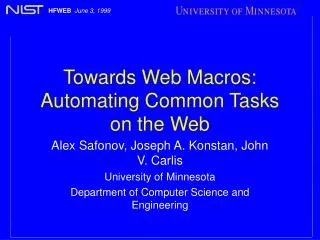
Towards Web Macros: Automating Common Tasks on the Web Alex Safonov, Joseph A. Konstan, John V. Carlis University of Minnesota Department of Computer Science and Engineering
Automatable Web Tasks: Examples • On-line flight reservations • NWA, Internet Travel Network, etc. • multiple, “equivalent” airports (SFO/SJC/OAK) • Cited reference search • re-run for each database, merge results • plug found citations into full-text DL • Persistent shopping cart • multi-vendor?
Actions to automate • Navigation; form filling and submission; user authentication • Iteration over multiple information services • integrate results • Connecting services “back-to-back”
Vision of a Solution: Web Macros • Client-side programs that: • Emulate user actions on the Web • Can be created by end users • Requirements for Web Macros • infer navigation and control • support parameters • deal with dynamic, unstructured data • maintain the browsing context
Related Work • Internet Scrapbook • Sugiura and Koseki, UIST 98 • InfoBeans • Bauer and Dengler, IUI 99 • AgentSoft’s LiveAgent • WebL • Kistler and Marais, WWW7
Proxy-based Prototype • Special URLs http://macros/...
“Get me here” Web macros • Goal: re-establish browsing context • authentication, hidden form fields, cookies • Iteratively generates and test macros • from longer history segments
Future Work • Concrete plans • intelligently comparing Web pages • let users specify start and end of macro • update macros based on playback “deviations” • Neat ideas • use browsing history for improving macros • visual manipulation environment for Web macros
Conclusion • Why automate common tasks • Requirements and our prototype system • Goals • A free system for automating Web tasks by end-users • Extensions to Programming by Demonstration techniques for the Web • Recommendations for content developers
Existing Tools • Bookmarks/favorites • record static URLs only • Server-based Tools • comparison shopping services; auction proxies; customizable home pages • limited flexibility: user is not in control • competing services are excluded