Section 7.1 Ion formation
Chapter 7 Ionic Compounds and Metals. Section 7.1 Ion formation. Chemical Bonds. A chemical bond is the force that holds two atoms together. Can form by the attraction between the positive nucleus of one atom and the negative electrons of another

Section 7.1 Ion formation
E N D
Presentation Transcript
Chapter 7Ionic Compounds and Metals Section 7.1Ion formation
Chemical Bonds A chemical bond is the force that holds two atoms together. • Can form by the attraction between the positive nucleus of one atom and the negative electrons of another • Can form between positive and negative ions
Valence Electrons • Electrons in the outermost principal energy level • Shown in the electron dot structures • Octet rule – atoms will gain, lose or share electrons to obtain 8 valence electrons • The valence electrons determine the bonding properties of the atom
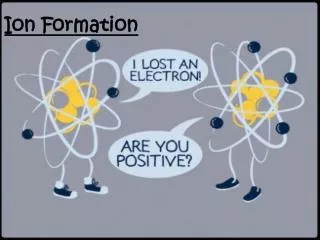
Positive Ion Formation • A positively charged ion is called a cation. • Positive ions are formed when an atom loses one or more valence electrons • Metals make positive ions
Negative Ion Formation • A negatively charged ion is called an anion. • Negative ions are formed when an atom gains one or more electrons in its valence shell. • Nonmetals make negative ions.
7.2: Ionic bonds and ionic compoundsFormation of an Ionic Bond • An ionic bond is the electrostatic force that holds oppositely charged particles together in an ionic compound • Compounds that contain ionic bonds are called ionic compounds. • Ionic compounds are formed between metals (+ charge) and nonmetals (- charge).
Binary Ionic Compounds • Contain a metallic cation and a nonmetallic anion. • Formation of Binary Ionic Compounds • Electron(s) is/are transferred from metal to nonmetal • Metal becomes positive, nonmetal becomes negative • Opposite charges attract
Properties of Ionic Compounds • Take the structure of a crystal lattice • Many units of positive and negative ions stick together in a three-dimensional geometric arrangement • Can conduct electricity when dissolved in water (they are electrolytes and break into ions when dissolved in water), but not in solid form • Melting point, boiling point and hardness depend upon how strongly the ions are attracted to each other
Formulas for Ionic Compounds • Monatomic ions are one-atom ions • Examples: Mg2+ , Br-1 • Oxidation numbers are the charges on ions • Note: some elements have multiple oxidation states – you will have a periodic table to tell this • Binary ionic compounds are made of two monatomic ions (one positive, one negative)
Formulas for Binary Ionic Compounds • Symbol for cation is written first, anion second • Subscripts tell the number of atoms of each element • What are the following compounds made of? • CaF2 1 calcium, 2 fluorine • Na2S 2 sodium, 1 sulfur • NaCl 1 sodium, 1 chlorine
Naming Binary Ionic Compounds • Name the cation first • Name the anion second with –ide at the end • Examples • CaF2 calcium fluoride • Na2S sodium sulfide • NaCl sodium chloride
Try Naming a few moreBinary Ionic Compounds • K2O potassium oxide • Al2S3 aluminum sulfide • Na3N sodium nitride
What if the cation has more than one oxidation state? • You tell which ion was used by putting a Roman Numeral after the name of the cation • Example: • CuS • We know S was -2 (that’s the only one it makes) • If there is only one atom of each element, the Cu must have been +2 • So, the name is written as Copper (II) sulfide [the “II” indicates the charge] • Make sure, especially with transition elements, that you are checking the oxidation states
Writing Formulas for Binary Ionic Compounds • Look up the charges for each element • For a compound to form, the total charge must balance out to zero (positive charges must equal negative charges) • Example: • Sodium bromide • Na is +1, Br is -1 • Only need one of each to balance • Formula is NaBr
Try writing some more formulasBinary Ionic Compounds • Potassium Iodide KI • Aluminum bromide AlBr3 • Magnesium chloride MgCl2 • Cesium nitride Cs3N
Formulas for Polyatomic Ionic Compounds • Polyatomic ions are ions that are made up of more than one atom • You will have a chart for these and do not have to memorize them. • Examples: • SO42- = sulfate • CN- = cyanide • NH4+ = ammonium
Naming Polyatomic Ionic Compounds • Name the cation first, anion second • Name the polyatomic as is – don’t change its name at all • Examples: • Ca3(PO4)2 calcium phosphate • Mg(CN)2 magnesium cyanide • NH4Cl ammonium chloride
Now you try naming Polyatomic Ionic Compounds • NaNO3 sodium nitrate • Ca(ClO3)2 calcium chlorate • Al2(CO3)3 aluminum carbonate
Writing formulas for Polyatomic Ionic Compounds • Same as binary ionic compounds EXCEPT you may not change anything in the polyatomic ion formula • Put them in a (parenthesis) and put subscripts outside that parenthesis • Example: • Calcium Nitrate • Ions are Ca2+ and NO3- • Formula will be Ca(NO3)2
Now you try writing formulas forPolyatomic Ionic Compounds • Sodium hydroxide NaOH • Copper (II) nitrate Cu(NO3)2 • Silver chromate Ag2CrO4
7.3: Metallic bonds and theproperties of metals • The electron sea model proposes that all the metal atoms in a metallic solid contribute their valence electrons to form a “sea” of electrons • Since the electrons are free to move, they are called delocalized electrons • A metallic bond is the attraction of a metallic cation for delocalized electrons
Properties of Metals(revisited) • Moderately high melting points • High boiling points • Malleable, ductile, durable • Conduct heat and electricity well • Transition metals are harder/stronger than alkali metals because the transition metals have more delocalized electrons