SlideServe
Menu
Préférences
© SlideServe · v2026

Complex Ion Formation

fulton-larson avatar
19 diapositives · 777 Views · Nov 14, 2014

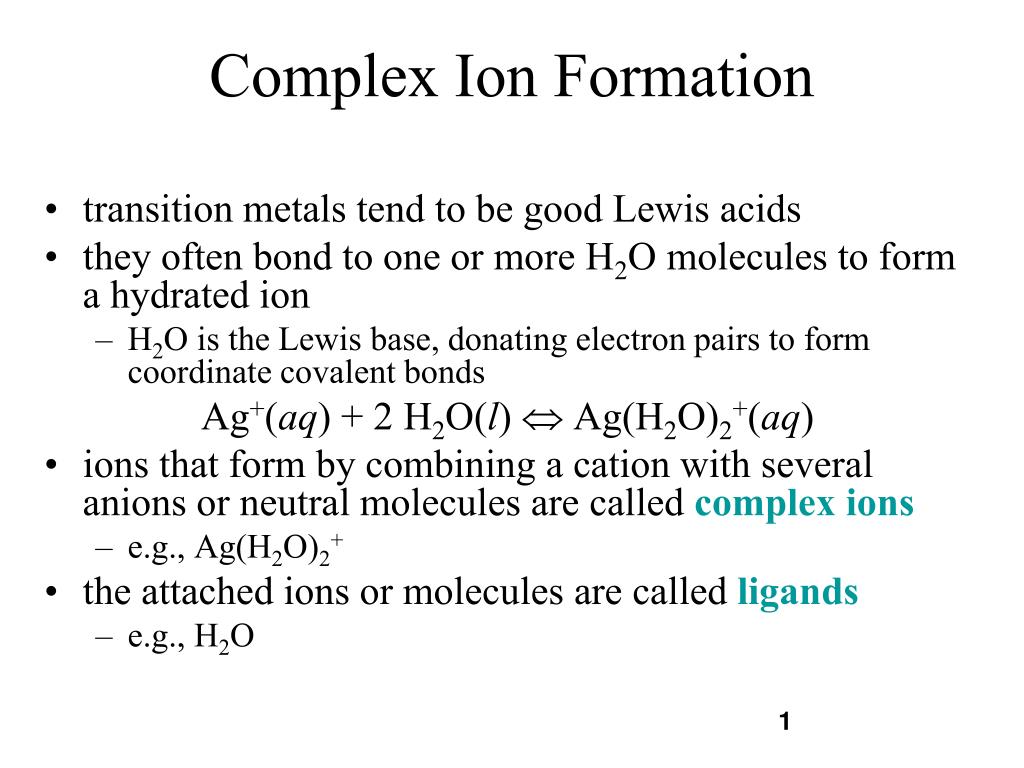
transition metals tend to be good Lewis acids they often bond to one or more H 2 O molecules to form a hydrated ion H 2 O is the Lewis base, donating electron pairs to form coordinate covalent bonds Ag + ( aq ) + 2 H 2 O( l )  Ag(H 2 O) 2 + ( aq )

Complex Ion Formation - slide 1
01 / 19Complex Ion Formation
1 / 17

Télécharger la présentation

Complex Ion Formation
Une image / un lien ci-dessous est fourni (tel quel) pour télécharger la présentation

Politique de téléchargement : le contenu du site vous est fourni TEL QUEL pour votre information et votre usage personnel ; il ne peut être vendu, concédé sous licence ni partagé sur d’autres sites sans l’accord de son auteur.Le contenu vous est fourni TEL QUEL, pour votre information et votre usage personnel uniquement. Téléchargez la présentation en cliquant sur ce lien. Lors du téléchargement, si vous ne parvenez pas à télécharger une présentation, l’éditeur a peut-être supprimé le fichier de son serveur.Pendant le téléchargement, si vous ne parvenez pas à obtenir une présentation, le fichier a peut-être été supprimé par l’éditeur.

F I N

Plus de contenu associé

Transcription de la présentation
  1. transition metals tend to be good Lewis acids they often bond to one or more H2O molecules to form a hydrated ion H2O is the Lewis base, donating electron pairs to form coordinate covalent bonds Ag+(aq) + 2 H2O(l)  Ag(H2O)2+(aq) ions that form by combining a cation with several anions or neutral molecules are called complex ions e.g., Ag(H2O)2+ the attached ions or molecules are called ligands e.g., H2O Complex Ion Formation

  2. if a ligand is added to a solution that forms a stronger bond than the current ligand, it will replace the current ligand Ag(H2O)2+(aq) + 2 NH3(aq) Ag(NH3)2+(aq) + 2 H2O(l) generally H2O is not included, since its complex ion is always present in aqueous solution Ag+(aq) + 2 NH3(aq) Ag(NH3)2+(aq) Complex Ion Equilibria

  3. the reaction between an ion and ligands to form a complex ion is called a complex ionformation reaction Ag+(aq) + 2 NH3(aq) Ag(NH3)2+(aq) the equilibrium constant for the formation reaction is called the formation constant, Kf Formation Constant

  4. NH3 M(H2O)42+ 3NH3 M(H2O)3(NH3)2+ M(NH3)42+ The stepwise exchange of NH3 for H2O in M(H2O)42+.

  5. Kf = Formation Constant M+ + L- ML Kd = Dissociation constant ML  M+ + L- Kd = 1 Kf

  6. In general: the solubility of an ionic compound containing a metal cation, that forms a complex ion, increases in the presence of aqueous ligands The Effect of Complex Ion Formation on Solubility

  7. COMPLEX ION EQUILIBRIA Transition metal Ions form coordinate covalent bonds with molecules or anions having a lone pair of e-. AgCl(s) Ag+ + Cl-Ksp = 1.82 x 10⁻¹⁰ Ag+ + 2NH3  Ag(NH3)2+Kf = 1.7 x 10⁷ AgCl + 2NH3  Ag(NH3)2+ + Cl- Keq = Ksp x Kf Complex Ion: Ag(NH3)2+ which bonds like: H3N:Ag:NH3 metal = Lewis acid ligand = Lewis base Kf = [Ag(NH3)2+] [Ag+][NH3]2 adding NH3 to a solution in equilibrium with AgCl(s) increases the solubility of Ag+

  8. Ex 16.15 – 200.0 mL of 1.5 x 10⁻³ M Cu(NO3)2 is mixed with 250.0 mL of 0.20 M NH3. What is the [Cu2+] at equilibrium? Cu2+(aq) + 4 NH3(aq)  Cu(NH3)22+(aq)

  9. Ex 16.15 – 200.0 mL of 1.5 x 10⁻³ M Cu(NO3)2 is mixed with 250.0 mL of 0.20 M NH3. What is the [Cu2+] at equilibrium? Cu2+(aq) + 4 NH3(aq)  Cu(NH3)22+(aq)

  10. Ex 16.15 – 200.0 mL of 1.5 x 10⁻³ M Cu(NO3)2 is mixed with 250.0 mL of 0.20 M NH3. What is the [Cu2+] at equilibrium? Cu2+(aq) + 4 NH3(aq)  Cu(NH3)22+(aq) since 2.7 x 10⁻¹³ << 6.7 x 10⁻⁴, the approximation is valid

  11. PROBLEM: In black-and-white film developing, excess AgBr is removed from the film negative by “hypo”, an aqueous solution of sodium thiosulfate (Na2S2O3), through formation of the complex ion Ag(S2O3)23-. Calculate the solubility of AgBr in (a) H2O; (b) 1.0M hypo. Kf of Ag(S2O3)23- is 4.7x10¹³ and Ksp AgBr is 5.0x10⁻¹³. Sample Problem 2 Calculating the Effect of Complex-Ion Formation on Solubility PLAN:

  12. Practice Problems on Complex Ion Formation Q 1. Calculate [Ag+] present in a solution at equilibrium when concentrated NH3 is added to a 0.010 M solution of AgNO3 to give an equilibrium concentration of [NH3] = 0.20M. Q2. Silver chloride usually does not ppt in solution of 1.0 M NH3. However AgBr has a smaller Ksp. Will AgBr ppt form a solution containing 0.010 M AgNO3, 0.010 M NaBr and 1.0 M NH3? Ksp = 5.0 x 10⁻¹³ Q3. Calculate the molar solubility of AgBr in 1.0M NH3?

  13. many metal hydroxides are insoluble all metal hydroxides become more soluble in acidic solution shifting the equilibrium to the right by removing OH− some metal hydroxides also become more soluble in basic solution acting as a Lewis base forming a complex ion substances that behave as both an acid and base are said to be amphoteric some cations that form amphoteric hydroxides include Al3+, Cr3+, Zn2+, Pb2+, and Sb2+ Solubility of Amphoteric Metal Hydroxides

  14. Most MOH and MO compounds are insoluble in water but some will dissolve in a strong acid or base. Al3+, Cr3+, Zn2+, Sn2+, Sn4+, and Pb2+ all form amphoteric complexes with water. Al(H2O)63+ + OH- ⇆Al(H2O)5(OH)2+ + H2O Al(H2O)5(OH)2+ + OH- ⇆ Al(H2O)4(OH)2+ + H2O Al(H2O)4(OH)2+ + OH- ⇆Al(H2O)3(OH)3  + H2O Al(H2O)3(OH)3 + OH- ⇆ Al(H2O)2(OH)4- + H2O Amphoteric Complexes

  15. an analytical scheme that utilizes selective precipitation to identify the ions present in a solution is called a qualitative analysisscheme wet chemistry a sample containing several ions is subjected to the addition of several precipitating agents addition of each reagent causes one of the ions present to precipitate out Qualitative Analysis

  16. a solution containing several different cations can often be separated by addition of a reagent that will form an insoluble salt with one of the ions, but not the others a successful reagent can precipitate with more than one of the cations, as long as their Ksp values are significantly different Selective Precipitation

  17. PROBLEM: A solution consists of 0.20M MgCl2 and 0.10M CuCl2. Calculate the [OH-] that would separate the metal ions as their hydroxides. Ksp of Mg(OH)2= is 6.3x10⁻¹⁰; Ksp of Cu(OH)2 is 2.2x10⁻²⁰. Sample Problem 3 Separating Ions by Selective Precipitation