Unraveling Frustration in Magnetism: Insights into Frustrated Antiferromagnets
20 likes | 122 Vues
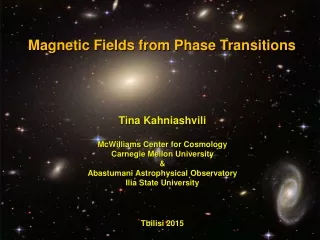
This research by Gregory S. Boebinger at Florida State University delves into the intriguing behaviors of frustrated triangular antiferromagnets, akin to curmudgeons unable to vote collectively. The study reveals unexpected stable spin arrangements and thermodynamic transitions in high magnetic fields, particularly examining new states observed at around 20T and 22T. Utilizing novel instrumentation, including a rotating calorimeter operating at millikelvin temperatures, this work not only advances our understanding of low-dimensional magnetic systems but also fosters student involvement across various academic levels.


Unraveling Frustration in Magnetism: Insights into Frustrated Antiferromagnets
E N D
Presentation Transcript
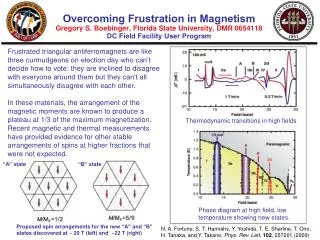
Overcoming Frustration in MagnetismGregory S. Boebinger, Florida State University, DMR 0654118DC Field Facility User Program Frustrated triangular antiferromagnets are like three curmudgeons on election day who can’t decide how to vote: they are inclined to disagree with everyone around them but they can’t all simultaneously disagree with each other. In these materials, the arrangement of the magnetic moments are known to produce a plateau at 1/3 of the maximum magnetization. Recent magnetic and thermal measurements have provided evidence for other stable arrangements of spins at higher fractions that were not expected. Thermodynamic transitions in high fields “B” state “A” state Phase diagram at high field, low temperature showing new states. N. A. Fortune,S. T. Hannahs,Y. Yoshida,T. E. Sherline,T. Ono, H. Tanaka,and Y. Takano, Phys. Rev. Lett.102,257201 (2009) Proposed spin arrangements for the new “A” and “B” states discovered at ~ 20 T (left) and ~22 T (right)
Overcoming Frustration in Magnetism Gregory S. Boebinger, Florida State University, DMR 0654118 DC Field Facility User Program This work was enabled by the development of unique instrumentation: a rotating calorimeter that operates at millikelvintemperatures. Developed as a Magnet Lab collaboration with Smith College, a liberal arts college for women, this instrument has made a whole new class of measurements on low-dimensional magnetic systems accessible to the users of the NHMFL. The project trained students at all levels: from introducing undergraduates to data collection and analysis, to graduate students and postdocs who have gone on to other research institutions in the United States and Europe. This work was international in its conception bringing samples from Japan, techniques from NHMFL in Tallahassee, and expertise from UF and Smith College. Calorimetry cell for measuring heat capacity Calorimetry cell in mechanical rotator designed for millikelvin temperatures