Things Fall Apart
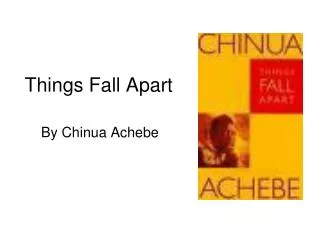
"Things Fall Apart" by Chinua Achebe delves into the intricate dynamics of Igbo culture, illustrating the impact of colonialism through the lens of its characters. In this study, we explore key elements such as the significance of cowries, kola nuts, and the role of oracles in decision-making. The personalities of Okonkwo, Unoka, Nwoye, and others reveal deep-seated values and conflicts. We’ll also analyze pivotal moments and philosophies that define the Igbo worldview, alongside commonly used terms relevant to the culture and society depicted in the novel.


Things Fall Apart
E N D
Presentation Transcript
Harmattan • A dusty wind that blows along the western coast of Africa in certain seasons
Cowries • Shells used in some African societies as money
Kola Nut • The large meaty nut of the kola tree, with several pieces in one shell
Oracle • A god who can foretell the future, usually through a human priest or priestess
Sisal • A type of vine with fibers that are often used for making ropes
Calabashes • Gourds used as containers
Pottage • A kind of stew
Plantains • Starchy fruit, similar to a banana, that must be cooked before it is eaten
Raffia • A fiber from a palm tree, used like a string
Kite • A bird of prey
Iron Horse • Bicycle
Bull-Roarer • Noise-maker made from the horn of a bull
Creepers • Vines growing on trees
Singlets • A man’s undershirt
Character ListDirections: Keep a running list of personality/physical traits for each of the characters below • Okonkwo (Oh-kawn-kwoh) – • Unoka (Ooh-no-kah) – • Nwoye (Nuh-who-yeh) – • Ikemefuna (Ee-keh-meh-foo-nah) – • Ekwefi (Eh-kweh-fee) – • Ezinma (Eh-zeen-mah) – • Ojiugo (Oh-jee-ooh-goh) – • Obierika (Oh-bee-air-ee-kah) – • Chielo (Chee-eh-loh) –
Chapters 1-2 Study Questions • 1. For what is Okonkwo famous in his clan in Umofia?2. How does Okonkwo feel about his father, Unoka? Why?3. Explain the proverb as it relates to Okonkwo: "If a child washed his hands, he could eat with kings."4. How do the men Umuofia decide what to do about the murder of a woman from their clan? What role do the women of Umuofia have in the decision?5. How do people of Umuofia react to the dark?6. What is the philosophy of war amongst the clans?7. What evidence of Okonkwo's spiritual life is found on his compound?