Understanding Electrical Circuits: Basics and Diagrams
Learn about electrical circuits, including series and parallel circuits. Discover how batteries, circuit diagrams, and current flow work. Explore circuit components and how resistance affects brightness in bulbs.


Understanding Electrical Circuits: Basics and Diagrams
E N D
Presentation Transcript
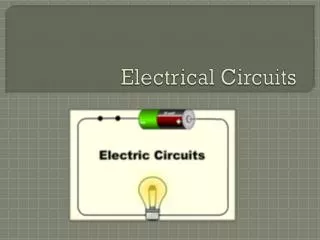
Electrical Circuit • Closed path through which charge can flow • A Circuit needs: • Source of energy (voltage) • Conductive path for charge to flow • Source of resistance (device to do work)
Batteries • Provide the energy (voltage) for charge to flow in a circuit • Have (+) and (-) terminals
Dry cell • Series of chemical reactions causes electrons to flow and accumulate at the (-) terminal • Used in portable electronics + terminal - terminal
Wet Cell • Has 2 connected metal plates submerged in an electrolyte: solution that conducts electricity • Ex: Car battery
Circuit Diagrams • Use symbols to represent parts of a circuit • Shows one or more complete paths that charge can flow
Current flow Battery + - Current always flows from positive (+) to negative (-) battery terminal
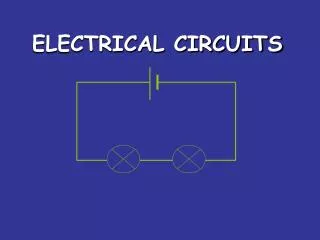
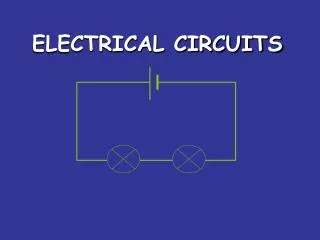
Series Circuits • Charge has only one path to flow • If one device stops working they all stop working! • Viewing series circuit
Series Circuits • Adding light bulbs to a series circuit increases resistance • CURRENT DECREASES, BULBS BECOME DIMMER
Parallel Circuits • Circuit with two or more paths for current to flow • If one device stops working the rest continue to work!
Parallel Circuits • Viewing Parallel Circuit • Homes and buildings are wired in parallel • Bulbs shine brighter in parallel than series • All Directly connected to battery
Parallel circuits • Current in branch depends on resistance • More current flows through the path of lowest resistance • Voltage is same across each branch